
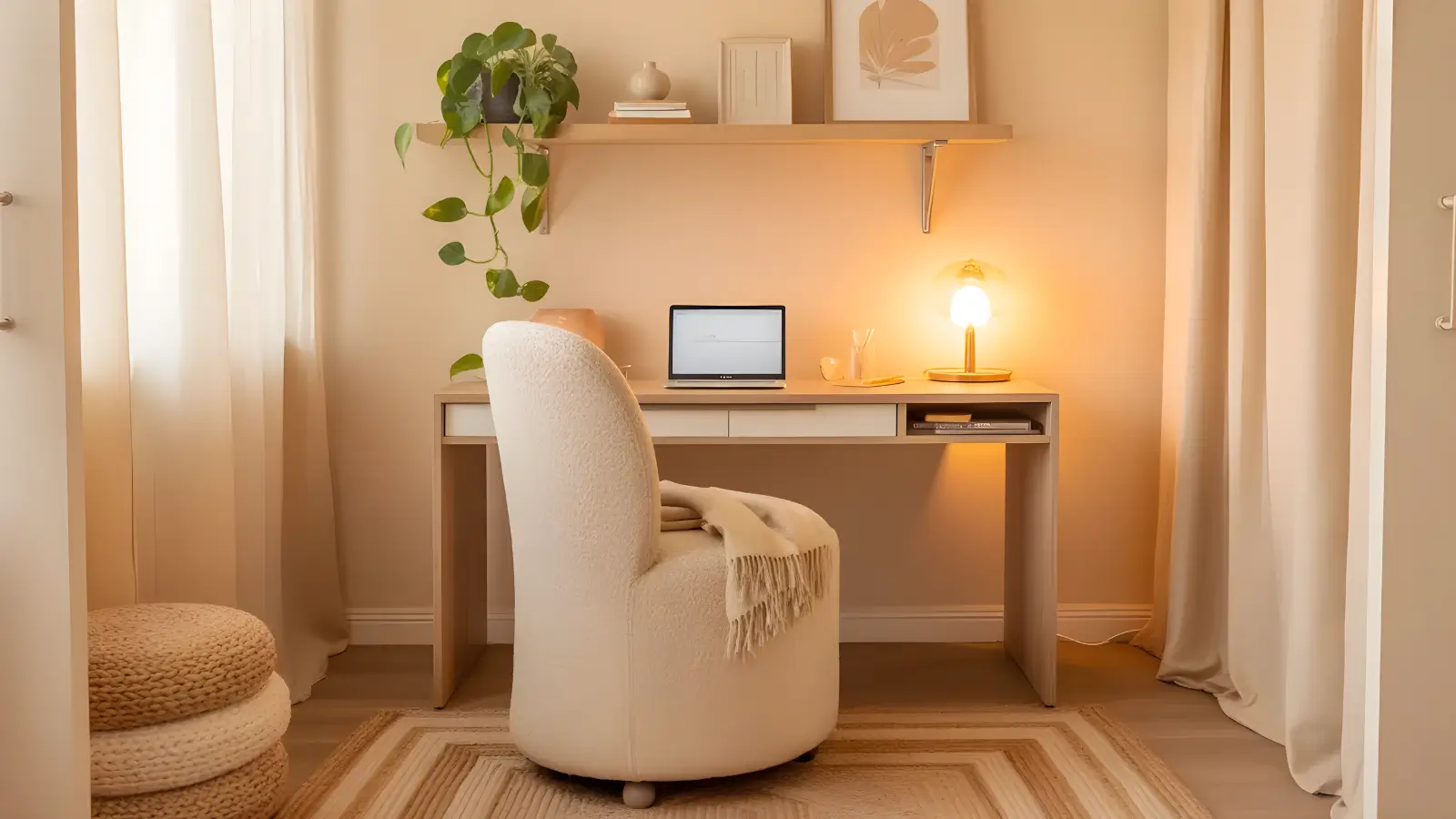

Introduction
If you work from home and your office still feels like a sterile cubicle that happens to be in your house, you’re not alone. Millions of women now spend their workdays in spare bedrooms, apartment corners, and converted closets—yet many of those spaces are still dominated by cold overhead lighting, bare walls, and furniture that prioritizes function over feeling. It doesn’t have to be that way. The best cozy home office ideas prove that warmth and productivity aren’t opposites; they’re partners.
When we talk about a cozy home office, we’re not talking about clutter. We’re talking about a workspace that wraps you in comfort the moment you sit down—one where the lighting is soft but effective, the textures invite you to stay a while, and every detail feels personal and intentional. Think warmth, comfort, ergonomic support, and touches that make the room unmistakably yours.
This guide is your complete roadmap. We’ll walk through how to find your cozy style, then cover every layer that builds the feeling: lighting, textures, color, furniture, plants, scent, sound, and temperature. You’ll also find dedicated sections for small-space and renter-friendly solutions, budget tiers from under $50 to $500, seasonal refresh ideas, and a thorough FAQ. By the end, you’ll have everything you need to turn even the tiniest, most temporary space into a warm home office you genuinely look forward to working in.
Why a Cozy Office Can Improve Your Work
It’s tempting to think that a “serious” workspace needs to look and feel like a traditional office—bright fluorescent lights, neutral gray walls, a no-nonsense desk. But environmental psychology tells a different story. Research published in the Journal of Environmental Psychology has consistently found that people perform better and report lower stress levels in spaces that include natural materials, warm lighting, and personal elements. A study in Building and Environment showed that thermal comfort, adequate daylight, and a sense of personal control over one’s surroundings are among the strongest predictors of workplace satisfaction and cognitive performance.
Cold, overly bright environments tend to increase cortisol, the stress hormone, while warm light and comfortable textures help activate the parasympathetic nervous system—the body’s “rest and focus” mode. That’s exactly where deep, creative, sustained work happens. Adding a plant, a soft rug, or a warm lamp isn’t decorating for decoration’s sake; it’s designing for how your brain and body actually function.
The key insight is this: coziness is not the enemy of productivity—it supports it. When your workspace feels like a place of refuge rather than obligation, you’re more likely to sit down willingly, focus deeply, and sustain your energy through the day. A cozy workspace doesn’t make you lazy. It makes you comfortable enough to do your best work.
Find Your Cozy Office Style
Before you buy a single throw pillow, it helps to know what flavor of cozy speaks to you. Not every warm home office looks the same, and that’s the beauty of it. Here are five popular style directions to help you find your starting point.
Hygge Scandinavian centers on light neutrals, natural wood, flickering candles, and an abundance of soft textures. If you’re drawn to white walls, sheepskin throws, and the quiet glow of a beeswax candle beside your laptop, this is your lane. It works beautifully for anyone who wants calm simplicity and a hygge home office that feels like a warm cloud.
Dark & Moody / Dark Academia goes in the opposite direction with deep greens, navy, charcoal, or rich burgundy walls, shelves packed with books, vintage brass lamps, and leather-bound journals. This style suits you if you find comfort in richness and depth rather than lightness—if a library at dusk feels more inviting than a sunlit café.
Japandi Calm blends Japanese minimalism with Scandinavian warmth: clean lines, a muted neutral palette, natural materials like linen and unfinished wood, and very intentional negative space. Choose this if clutter stresses you out, but sterile modernism feels too cold.
Cottagecore / Soft Cozy brings in florals, rattan, botanical prints, warm whites, and vintage-inspired details. It’s perfect for the person who wants their office to feel like a sunny morning in an English garden cottage—feminine, soft, and a little romantic.
Eclectic / Maximalist Cozy is for the collector. Gallery walls, layered rugs, stacks of books, travel souvenirs, and a mix of patterns and periods all come together in a space that’s warm because it’s full of life. If you feel most at home surrounded by things you love, this style permits you to display them all. For more inspiration across these aesthetics, explore our guide to aesthetic home office ideas.

Cozy Lighting – Your Highest-Impact Upgrade
If you only change one thing about your home office, change the lighting. Nothing transforms a space from cold to cozy faster than the right light. According to Houzz’s home office trends reports, lighting upgrades consistently top the list of changes that homeowners say made the biggest difference in how their workspace feels.
Layered Lighting
The secret to a cozy office aesthetic is layers. Think of your lighting in three tiers. Ambient lighting provides the overall glow of the room—this might be a floor lamp with a linen or paper shade, a table lamp on a shelf, or even a string of warm fairy lights along a bookcase. Task lighting is your focused, functional layer: a good desk lamp that illuminates your keyboard and notebook without casting glare on your screen. Accent lighting adds atmosphere and depth—picture lights above art, a candle on your desk, LED strip lights behind a monitor, or a small lamp in a reading corner.
The reason many home offices feel harsh is that they rely on a single overhead ceiling light. Overhead-only lighting casts flat, shadowless illumination that mimics a commercial office and washes out the warmth of your décor. By distributing light across multiple sources at different heights—a floor lamp in one corner, a desk lamp at work height, a candle at eye level—you create pools of warm light and gentle shadow that make the room feel dimensional and intimate.
Warm Light & Placement
Color temperature matters enormously. Look for bulbs rated between 2700K and 3000K, which produce a warm, golden tone rather than the cool blue-white of standard office bulbs. If your existing fixtures use cool bulbs, swapping them out costs a few dollars and makes an immediate difference.
Placement is equally important. Put your primary desk lamp to the side of your monitor, not directly behind it—this prevents glare and reduces eye strain. If you have a reading or break corner, give it its own lamp so you have a reason to move away from the screen. And for video calls, place a soft light source in front of you and slightly above eye level, rather than directly behind your webcam, which would silhouette your face. A warm lamp on your desk or a ring light set to its warmest setting will keep your calls looking natural and your room looking inviting on camera.
Textures & Textiles – The “Cozy Multiplier”
Lighting sets the mood, but texture is what makes you want to reach out and touch the room. Textiles add visual warmth, absorb sound, and transform even the most basic furniture into something that feels considered and inviting. The rule of thumb is simple: layer at least three different textures to make a space feel rich rather than flat.
Rugs are one of the most powerful tools in a cozy office setup. A rug under your desk and chair—or one that defines your entire office zone—instantly softens hard floors and signals that this area is special. For materials, wool rugs are naturally warm and durable. A jute or sisal rug works well as a base layer, especially when you add a smaller, softer rug on top—perhaps a faux fur or a plush wool in your accent color. If your chair has wheels, look for a low-pile rug that still allows movement, or consider switching to a chair with glides.
Throws and cushions are the fastest way to cozy up furniture you already own. Drape a chunky knit or waffle-weave blanket over the back of your desk chair for chilly mornings, or place one on a reading chair in a break corner. A lumbar cushion in velvet, bouclé, or linen adds both support and softness to an ergonomic chair that might otherwise look clinical. Even one or two pillow covers in a warm fabric can change the entire feeling of a room.
Curtains are often overlooked in offices, but they do triple duty. They soften natural light so it doesn’t create harsh glare on your screen, they absorb sound to reduce echo—especially important on calls—and they visually warm the room in a way that bare blinds never can. Linen curtains in a warm white or oatmeal let light filter through gently, while heavier velvet curtains in a deeper tone add drama and insulation. If your window is small, hang the rod wider than the frame and let the curtains pool slightly at the floor to make the window appear larger, and the room feel more generous.
Warm Colors & Wall Treatments
Color is one of the most immediate ways to set the emotional tone of your workspace. Cool grays and bright whites can feel crisp but also clinical; warm tones pull you in and make a room feel like a place you’d choose to spend time. The palette of a warm home office tends to live in the range of warm whites, cream, beige, caramel, terracotta, olive, sage, and deep green. Even navy and charcoal can feel warm when paired with wood, brass, and soft textiles.
You don’t need to paint every wall a bold color. One accent wall behind your desk in a rich terracotta or deep olive can anchor the room while the remaining walls stay neutral. Alternatively, you can introduce bolder colors in smaller doses through artwork, cushion covers, a rug, or your curtains. The key is to have at least one warm tone somewhere in your sightline while you work.
If you’re a renter who can’t paint, you still have excellent options. Peel-and-stick wallpaper has improved dramatically and now comes in beautiful textures and patterns—linen-look, floral, subtle geometric—that remove cleanly when you move. A single large piece of art in a warm palette can function almost like an accent wall. Fabric panels or a woven tapestry hung with removable hooks add color, texture, and sound absorption all at once. And a gallery wall assembled with Command strips and removable hooks lets you curate a personal display without drilling a single hole. For more inspiration on transforming your walls, take a look at our collection of wall decor ideas.
Cozy Furniture That Still Supports Your Body
A beautiful office that leaves you with back pain by 3 p.m. isn’t truly cozy—it’s just pretty. The goal is furniture that supports long hours of work and looks like it belongs in a space you’ve lovingly designed.
The Chair
Your desk chair is where coziness and ergonomics must meet. Look for chairs that offer proper lumbar support, adjustable height, and a comfortable seat depth, but that come in warm, tactile fabrics instead of black mesh and plastic. Upholstered chairs in bouclé, velvet, or a textured woven fabric in colors like cream, sage, blush, or camel can look stunning while still being fully functional. Many mid-range ergonomic chairs now come in these finishes as manufacturers catch up with the demand for home-friendly aesthetics.
If you already own a good ergonomic chair that happens to be an eyesore, work with what you have. A sheepskin draped over the back, a beautiful lumbar pillow, and a matching seat cushion can disguise almost any office chair. The point isn’t to sacrifice your spine for aesthetics—it’s to dress your functional furniture in clothes that match the room. What you want to avoid, if the vibe matters to you, is an aggressive, all-black racing-style or corporate mesh chair sitting in the middle of an otherwise soft, warm space. It will always pull the eye and undercut the coziness you’ve built around it.
Desk & Reading Corner
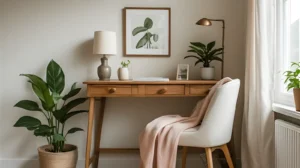
For desks, warm wood or wood-look surfaces in oak, walnut, or pine tones feel inherently cozier than glass, metal, or cool-toned laminate. Rounded corners and tapered legs soften the look further. If you need storage, a desk with a small drawer or an open shelf below keeps essentials close without requiring a separate filing cabinet. If you’re working in a very tight space, look into our roundup of space-saving furniture ideas for desks that fold, float, or tuck into corners.
If your room allows it, consider carving out a small reading or break corner: a compact armchair, a floor lamp, a tiny side table, and a throw blanket. This gives you a place to read, think, or take calls that’s physically separate from your desk. Even in a small room, you can visually separate the “work zone” from the “rest zone” by using a different rug or a change in lighting. The act of moving from desk to armchair signals to your brain that you’re shifting modes, which helps with focus when you return.
Plants, Scent & Multi-Sensory Coziness
A truly cozy workspace engages more than just your eyes. The best cozy home office ideas consider what you smell, hear, and feel against your skin, not just what you see.
Plants bring life, color, and a subtle psychological benefit—studies consistently link the presence of indoor plants with reduced stress and improved concentration. You don’t need a green thumb. Snake plants, pothos, ZZ plants, and peace lilies are all famously forgiving, tolerating low light and irregular watering. Place a small plant on your desk where you can see it as you work, trail a pothos from a high shelf, or set a larger plant on the floor beside your desk to fill an empty corner. Even a single plant changes the energy of a room.
Scent is one of the most underrated tools for setting a mood. A candle, a reed diffuser, or a quick spritz of room spray can mark the beginning of your workday like a ritual. Consider matching scents to the time of day or the task at hand: citrus or peppermint for an energizing morning start, cedarwood or amber for deep afternoon focus, and lavender or chamomile as you wind down in the evening. If open flames aren’t practical—especially in a small or shared space—an electric diffuser with essential oils gives you the same sensory benefit without the risk.
Sound and temperature round out the picture. If your home is noisy or too quiet, background sound can work wonders. Apps and websites offering café ambience, gentle rain, or lo-fi music create an audio cocoon that helps you focus. Soft furnishings—your rug, curtains, throw pillows—also dampen echo, which is especially noticeable on video calls. For temperature, a small ceramic heater under your desk or a heated foot mat can be a game-changer in winter, keeping you warm without heating the entire house. In summer, a small fan and breathable linen textiles maintain comfort without losing the cozy feeling.
Cozy Small Office Ideas & Renter-Friendly Hacks
You don’t need a dedicated room to have a cozy workspace. Some of the warmest, most inviting setups live in closets, bedroom corners, and tucked-away alcoves. The principles are the same—light, texture, color, personal touches—you just apply them at a smaller scale.
Tiny Spaces and Closets
The closet office, or “cloffice,” has become a beloved solution for anyone short on square footage. A narrow desk or floating shelf at the right height, one or two shelves above for storage and display, a warm-toned lamp, and a small plant or framed print are all you need. Add a curtain or sliding door panel that you can close at the end of the day, and you’ve created a small cozy home office that completely disappears when work is done. Paint or line the interior walls with peel-and-stick wallpaper to make the nook feel intentional rather than improvised.
A bedroom or living room corner works beautifully when you define it as its own zone. A rug that sits only under the desk area, a dedicated lamp, and perhaps a small bookshelf or floating shelves signal that this corner has a purpose. The rug, in particular, acts as a visual boundary—when you step onto it, you’re “at work,” and when you step off, you’re home. For more ideas on making small spaces work hard and look beautiful, see our guides to small apartment decor ideas for women and studio apartment decor ideas for women.
Under-stairs nooks and alcoves can become surprisingly charming offices. Because these spaces are architecturally distinct, they already feel like their own room. Add floating shelves that follow the angle of the stairs, warm lighting, and a cushioned chair, and the space reads as an intentional design choice rather than an afterthought.
Renter-Friendly Solutions
If you can’t paint, drill, or make permanent changes, you can still build a cozy home office that feels yours completely. Command hooks and adhesive strips hold everything from framed prints to floating shelves to string lights, and they come off cleanly when you leave. Peel-and-stick wallpaper and tile decals let you add pattern and warmth to a wall or even a desktop surface. Leaning a large mirror or oversized art against a wall eliminates the need for hardware and looks effortlessly stylish. Freestanding bookcases can serve as room dividers in studio apartments, creating a sense of separation between your work area and living space without touching a single wall. The beauty of renter-friendly solutions is that they travel with you—every piece you invest in can move to your next space.
Tech & Cable Management – Keeping Coziness with Screens
Screens, cables, and chargers are a reality of any home office, but they don’t have to dominate the visual landscape. A few simple choices keep your tech functional without breaking the cozy spell.
Cable management makes a surprising difference. A cable management box tucked behind or beneath your desk hides power strips and tangled cords. Adhesive cable clips run wires neatly along the underside of your desk, and fabric cable sleeves bundle multiple cords into a single, unobtrusive line. These are inexpensive fixes that instantly make a desk look calmer.
Monitor risers and laptop stands in wood, bamboo, or walnut finishes elevate your screen to ergonomic height while blending naturally into a warm workspace. A desk mat in leather, faux leather, or cork softens the area around your keyboard and gives your desk a polished, intentional look. If you spend long hours at the screen, consider enabling your display’s warm or night-mode setting during the afternoon and evening—it reduces blue light exposure, eases eye strain, and keeps the warm glow of your office consistent from the lamps to the screen.
Cozy Home Office Ideas by Budget
You don’t need to furnish an entire room at once. Coziness is built in layers, and even a very small investment can shift how your office feels. Here’s how to approach it at three different price points.
Under $50
This tier is about quick, high-impact additions that you can do this weekend. A soft throw blanket to drape over your chair (around $15–$20), two new cushion or pillow covers in a warm fabric ($10–$15 for a pair), one small low-maintenance plant like a pothos in a simple pot ($8–$12), two warm-toned LED bulbs to replace your current cool ones ($5–$8), and a candle or small reed diffuser ($8–$12). These five changes alone—costing roughly $45—will noticeably transform the mood of your workspace. Focus on the items closest to where you sit, because those are what you’ll see and feel all day.
$50–$200
With a bit more room, you can start layering. Add an area rug to define your office zone ($40–$80), a floor lamp or a quality desk lamp with a warm shade ($30–$60), a pair of woven baskets for storage that doubles as texture ($15–$25), and simple linen or cotton curtains to soften a window ($25–$40). A sample allocation might look like $60 for the rug, $45 for the lamp, $20 for baskets, and $35 for curtains. At this level, you’re creating a foundation that makes the space feel like a cohesive, intentional room rather than a corner with a laptop on a table.
$200–$500
This budget opens the door to bigger upgrades. A comfortable, aesthetically pleasing desk chair ($150–$300) or a warm-toned wood desk ($100–$250) can anchor the room. A reading chair for a break corner ($80–$150 at secondhand or budget retailers), a more substantial wool or cotton rug ($80–$150), and upgraded curtains or a set of peel-and-stick wallpaper panels ($30–$60) round out the space. You might allocate $200 toward the chair, $120 toward a desk or reading chair, $100 toward the rug, and $80 toward curtains and wall treatments. At this tier, you’re building a room that looks and feels like it was designed, not just assembled.
Seasonal Cozy Office Refreshes
One of the joys of a layered cozy office is that it’s easy to refresh with the seasons—no major overhaul required, just a few swaps that keep the space feeling alive and current.
Spring is the time to lighten up. Swap heavy throws for lighter cotton or linen blankets, trade dark cushion covers for softer pastels or botanical prints, and bring in a vase of fresh flowers or a new small plant. Switch your diffuser scent to something green and bright—eucalyptus, lemon, or fresh linen.
Summer calls for fewer layers and more natural light. Pull back the curtains or switch to sheers, remove the extra rug layer if your floor gets warm, and let the room breathe. Light, airy fabrics and a clean desk create a workspace that feels refreshing rather than heavy.
Fall is where cozy really comes into its own. Introduce warmer accent colors—rust, burnt orange, burgundy, mustard—through cushion covers, a new throw, or a small piece of art. Bring out the candles, switch to deeper scents like cinnamon, clove, or amber, and add an extra layer to your rug stack.
Winter is the season to go all in. Thick blankets, a heated foot mat or small space heater, layered rugs, extra lamps to compensate for shorter days, and the richest, warmest scents you own. This is the time of year when a cozy work-from-home setup pays for itself in comfort and motivation. For a deeper dive into switching your décor with the calendar, explore our guide to seasonal home decor ideas.
FAQ – Cozy Home Office Ideas
How do I make my home office feel cozy without clutter?
Coziness comes from sensory richness, not from quantity. Focus on a few high-impact layers—warm lighting, one or two textiles, a plant, and personal artwork—rather than filling every surface. Use closed storage like woven baskets, a desk drawer, or a small cabinet to keep supplies out of sight. The goal is a room that feels warm and full of character, but where every item either serves a function or genuinely brings you joy.
What colors make a home office feel warm and inviting?
Warm whites, cream, beige, caramel, terracotta, olive, sage green, and deep forest green are all excellent choices for a cozy office palette. Even cooler tones like navy can feel warm when balanced with wood, brass hardware, and soft textiles. Start with a neutral base and introduce one or two richer accent colors through an accent wall, rug, or cushion covers.
How can I create a cozy home office in a very small space?
Small spaces can actually feel cozier than large ones because the warmth is concentrated. Use a rug and a dedicated lamp to define your work zone, even if it’s just a corner. Floating shelves save floor space while giving you room for plants and personal items. Keep your color palette cohesive so the small area feels intentional, and use a mirror or light-colored walls to prevent it from feeling cramped. Our guides to cozy home office ideas for small spaces and small apartment decor ideas for women offer many more specific solutions.
What is the best lighting for a cozy home office?
Layered lighting with warm bulbs is the single best upgrade. Use bulbs in the 2700K–3000K range for a golden glow, and distribute light across at least two or three sources: a desk lamp for task lighting, a floor or table lamp for ambient warmth, and an accent source like a candle or string lights for atmosphere. Avoid relying on a single overhead fixture, which tends to flatten the room and kill the cozy feeling.
How can I make my work-from-home desk setup look cozy?
Start with the surface itself—a desk mat in leather, cork, or a warm fabric softens the tech zone. Add a small plant or a vase with dried flowers, a candle or diffuser, and a warm-toned desk lamp. Manage your cables so they’re hidden, and consider a monitor riser in wood or bamboo to bring warmth to the area around your screen. A mug that you love, a small tray for pens, and one personal item—a photo, a crystal, a small piece of art—complete the picture without creating clutter.
What plants are best for a cozy home office?
For low-maintenance greenery, pothos, snake plants, ZZ plants, and peace lilies are hard to kill and thrive in the indirect light typical of home offices. If your space gets good natural light, a fiddle leaf fig or a rubber plant makes a beautiful floor-standing statement. Trailing plants like string of pearls or philodendron look wonderful on a high shelf or in a hanging planter, adding life to vertical space you might not otherwise use.
How do I turn a closet into a cozy home office?
Remove the closet doors or replace them with a curtain you can draw closed at the end of the day. Install a floating shelf or narrow desk at a comfortable working height, and add one or two shelves above for books, plants, and décor. Line the back wall with peel-and-stick wallpaper in a warm pattern to make the interior feel special. A wall-mounted sconce or clip-on lamp provides warm light without taking up desk space. The enclosed nature of a closet actually works in your favor—it naturally feels like a little nook, which is inherently cozy.
How can I make a rental home office cozy if I can’t paint or drill?
You have more options than you might think. Peel-and-stick wallpaper comes in hundreds of patterns and removes cleanly. Command strips and hooks support framed art, shelves, and even light fixtures. Lean a large art piece or a mirror against the wall for impact without holes. Freestanding furniture like bookcases and room dividers doesn’t touch the walls at all. Rugs, curtains with tension rods, lamps, throws, and plants require zero modifications to the space. Every cozy layer discussed in this guide can be applied in a rental without risking your security deposit.
Can a cozy office still look professional on video calls?
Absolutely—in fact, a warm, well-styled background often looks more polished on camera than a bare wall. A bookshelf, a plant, or a simple piece of art behind you gives the frame visual interest. Warm lighting from a lamp in front of you and slightly to one side is flattering and professional. Just avoid clutter in the frame, and make sure your background is intentional rather than accidental. A cozy office reads as “put-together and personal” on a call, not casual or unprofessional.
How often should I refresh or update my cozy home office?
A seasonal refresh—small textile swaps, a new scent, fresh flowers—four times a year keeps the space feeling alive without requiring much effort or money. Beyond that, listen to how the room makes you feel. If you sit down and feel energized and comfortable, the space is working. If something feels stale or uninspiring, that’s your cue to change a detail. The beauty of a layered cozy setup is that you can swap one element—a throw, a print, a plant—and the whole room feels different.
Conclusion
A cozy home office isn’t built in a single shopping trip—it’s layered, piece by piece, until the room feels like it’s holding you. Warm light, soft textures, intentional color, a living plant, a scent that grounds you: these are the ingredients, and none of them require a big budget or a big room. Whether your space is a full room or a corner of your bedroom, the principles are the same.
Here’s your challenge for this week: choose one cozy style that resonates with you, pick one budget tier, and make two or three small changes. Swap a bulb for a warm one. Drape a throw over your chair. Bring home a plant. You’ll feel the difference the moment you sit down to work.
When you’re ready to keep going, save this guide and explore our articles on aesthetic home office ideas, wall decor ideas, seasonal home decor ideas, and studio apartment decor ideas for women for even more inspiration. Your cozy workspace is waiting—go build it, one layer at a time.