

Introduction
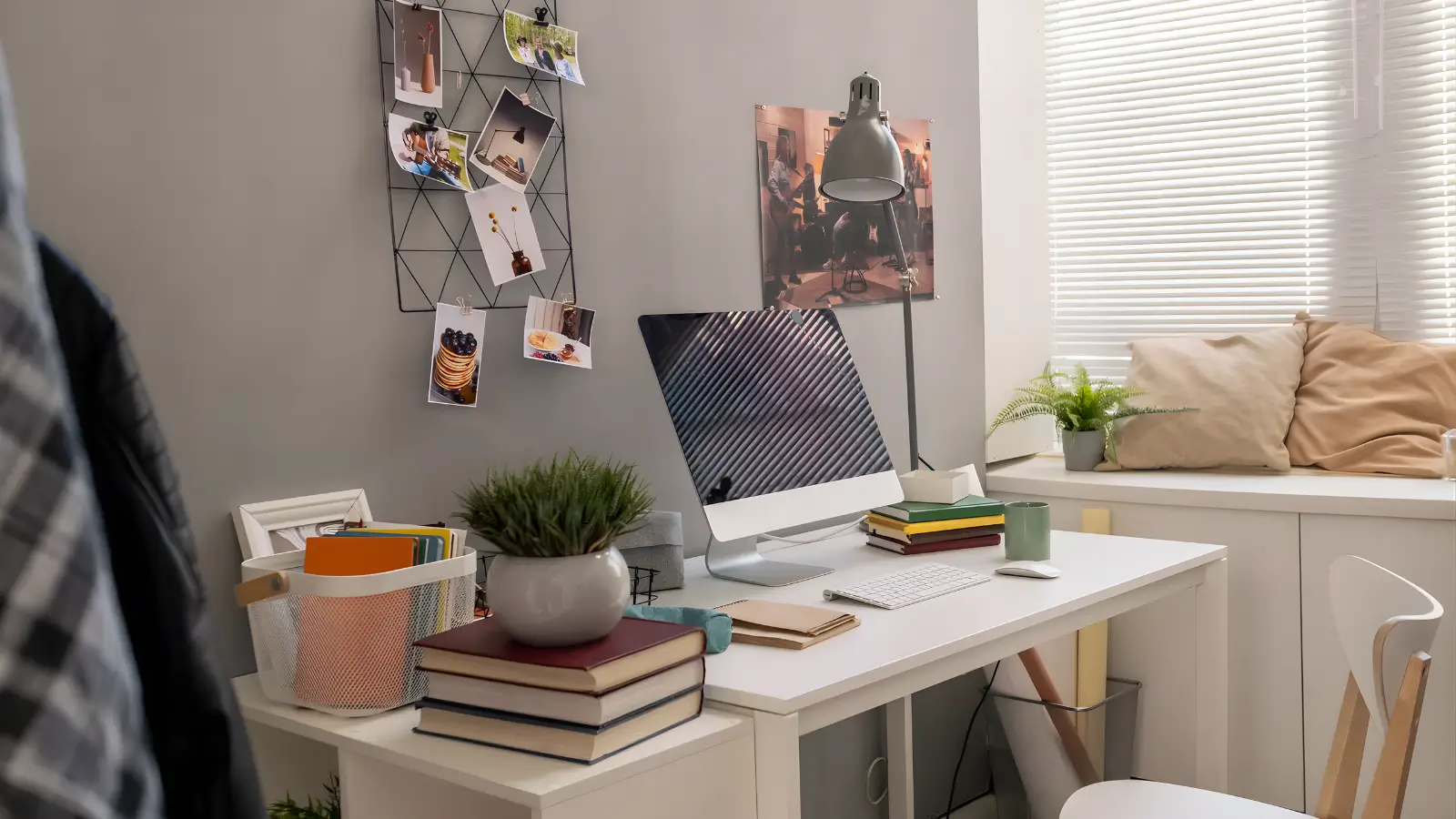
Over the past few years, working from home has quietly turned our offices into the most-used rooms in the house—right after the bedroom. We spend eight, nine, sometimes ten hours a day at our desks, yet most productivity advice skips right past the thing staring us in the face the entire time: how the room actually looks and feels. Your environment directly shapes your focus, your mood, and your energy. If your workspace feels cluttered, dull, or thrown together, your workday will feel that way too.
That’s where aesthetic home office ideas come in—and no, we’re not just talking about making things Pinterest-pretty. A truly aesthetic workspace is one where style, ergonomics, and lighting work together so seamlessly that you want to sit down and get to work every morning. It looks beautiful on camera, it supports deep focus, and it reflects who you are.
In this guide, you’ll find style-by-style setup guides for eight distinct aesthetics—from Japandi to dark academia to cozy cottagecore—along with help choosing the right one for you, desk styling tips, lighting strategies, color palette recipes, small-space layouts, video call background advice, and ideas across three budget tiers. Whether you’re working from a dedicated room or a 120-centimeter desk tucked into a bedroom corner, there’s something here for you.
This pillar pairs naturally with our broader home office design resources, our guide to wall decor ideas, and our roundup of space-saving furniture ideas—so you’ll find links to those throughout.
Why Your Home Office Aesthetic Matters
This isn’t just about vanity. A growing body of research in environmental psychology shows that the visual qualities of your workspace—color, order, natural elements, light—have a measurable effect on how well you think, how long you can focus, and how you feel at the end of the day. Research published by the American Society of Interior Designers (ASID) on the neuropsychology of space shows that visual clutter increases cognitive load, making it harder to concentrate and easier to feel overwhelmed. When your desk and surroundings are visually chaotic, your brain is quietly spending energy processing that chaos instead of channeling it into your work.
Color matters too. Cool blues and greens have been linked to improved focus and a sense of calm, while warm neutrals promote comfort and reduce anxiety. Even adding a single plant to your desk can lower stress levels—biophilic design research consistently shows that natural elements in indoor spaces reduce cortisol and improve creative thinking. The takeaway is simple: your visual environment is a productivity tool, and one of the most underused ones at that.
Beyond focus, there’s the emotional side. Your home office is the room where you spend most of your waking hours. If it feels beautiful, intentional, and “you,” you start the day with more energy and end it with less resentment. That’s not fluffy design talk—it’s the practical reality of spending thousands of hours in one spot. Aesthetics and function aren’t competing priorities. They reinforce each other.
So before you add anything to your cart—before the desk lamp, the floating shelf, the rattan basket—take a step back and choose an aesthetic direction first. Everything else flows from that decision.
How to Choose Your Home Office Aesthetic
With so many beautiful home office design ideas floating around, it’s easy to get stuck in inspiration-gathering mode and never actually commit. The trick is to filter options through your specific situation. Ask yourself these four questions:
- What kind of work do you do most? Deep-focus writing and analysis thrive in calm, minimal environments. Creative work often benefits from a more stimulating, layered space. If you’re on video calls all day, your background matters as much as your desk.
- How much natural light does your space get? A north-facing bedroom corner calls for a very different palette than a sun-drenched spare room. Dark aesthetics can feel oppressive without enough light or the right layered lighting plan, while airy coastal looks fall flat in dim rooms.
- What colors genuinely make you feel calm or energized? Forget trends for a moment. If deep green makes you feel grounded and focused, lean into that. If you can only relax surrounded by warm whites and soft textures, that’s your answer.
- What does your existing furniture look like? Working with what you have saves money and creates coherence. Light wood frames fit Japandi or Scandinavian styles. Dark wood or leather pieces lean toward dark academia. Black metal and raw surfaces suggest industrial.
Here’s a quick reference to map your answers to the right aesthetic direction:
- Minimalist / Scandinavian — Calm, clean, focused. Best for deep-focus work in well-lit spaces.
- Japandi — Warm minimalism with natural texture. Suits thoughtful, detail-oriented work.
- Dark Academia — Rich, intellectual, layered. Ideal for writers, readers, and researchers.
- Moody / Dark — Dramatic and cocooning. Great for creative work and evening workers.
- Coastal / Light & Airy — Bright, breezy, optimistic. Perfect for collaborative or high-energy roles.
- Cottagecore / Cozy — Soft, warm, inviting. Suits anyone who wants their office to feel like a hug.
- Industrial / Loft — Raw, edgy, functional. Works well for tech, design, and maker work.
- Maximalist / Eclectic — Bold, personal, layered. Best for creatives who draw energy from visual stimulation.
Once you’ve identified one or two styles that resonate, dive into the full setup guides below.
8 Aesthetic Home Office Styles (Full Setup Guides)
This is the heart of the guide. Each aesthetic home office style below follows the same structure: a description of the vibe and who it suits, then a detailed breakdown of palette, furniture, decor, lighting, and ideal work type. Use these as complete roadmaps—pick your style and follow the recipe.
Minimalist / Scandinavian Aesthetic
The minimalist home office is the quiet achiever of aesthetic workspaces. It strips away everything unnecessary so the few things left—a clean desk, a well-chosen lamp, one piece of art—feel intentional and calming. Scandinavian minimalism adds warmth through natural materials and soft textures, so it never feels cold or sterile. This aesthetic is ideal if you do deep-focus work, get distracted easily, or simply feel calmer when surfaces are clear.
- Color palette: Warm white, soft grey, pale oak, black accents, with optional dusty blue or sage green as a single accent color.
- Key furniture: A simple desk in light wood or matte white (think IKEA LAGKAPTEN on light trestle legs), a white or light grey ergonomic chair with a clean silhouette, open floating shelves, or a single closed-door cabinet to keep storage hidden.
- Decor & accessories: One or two pieces of simple line art, a single trailing pothos or small snake plant, a ceramic desk organizer, a wool or linen throw draped over the chair.
- Lighting: A slim desk lamp with a linen or matte white shade, warm-white LED bulbs (2700–3000K), and as much natural light as possible.
- Best for: Writers, analysts, project managers—anyone who needs calm focus without visual noise.
Japandi Aesthetic
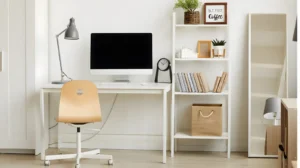
Japandi blends the warmth of Japanese wabi-sabi with Scandinavian functionalism, creating a home office aesthetic that feels grounded, organic, and quietly luxurious. It celebrates imperfection—handmade ceramics, natural grain in wood, linen that wrinkles. If minimalism feels too cold for you but you don’t want clutter, Japandi is the sweet spot. It suits detail-oriented, thoughtful work and anyone who finds calm in natural textures.
- Color palette: Warm white, mushroom, taupe, charcoal, with accents in terracotta or muted olive. Avoid bright or saturated colors.
- Key furniture: A solid wood desk with visible grain (walnut or oak), a low-profile chair in a neutral woven fabric or natural leather, open wood-and-metal shelving, and a low console or credenza for storage.
- Decor & accessories: A single branch in a stoneware vase, handmade pottery, a woven desk mat, linen curtains, a small bonsai or peace lily, and one or two pieces of textured, neutral artwork.
- Lighting: A paper or linen pendant, a ceramic table lamp with a warm glow, and natural light filtered through sheer linen curtains.
- Best for: Designers, strategists, editors—work that requires sustained attention to detail in a calm, warm environment.
Dark Academia Aesthetic
The dark academia home office channels old-world libraries, candlelit study rooms, and the romanticism of intellectual pursuit. It’s rich, warm, and layered—think leather-bound books, brass desk accessories, and deep green or burgundy walls. This aesthetic has surged in popularity and shows no signs of fading, especially among writers, researchers, and anyone who feels most productive when surrounded by a sense of history and depth.
- Color palette: Deep forest green, mahogany, cream, antique brass, charcoal brown. Walls in dark green or warm dark brown work beautifully as an accent.
- Key furniture: A dark wood desk (vintage or reproduction), a tufted leather or velvet desk chair, a tall wooden bookcase, a brass or wood desk lamp.
- Decor & accessories: Stacked hardcover books (styled vertically and horizontally), a globe or vintage map, brass pen holder and letter tray, a small fern or ivy, framed botanical prints or old portraits, a leather desk pad.
- Lighting: A brass banker’s lamp or green-shaded library lamp, warm amber bulbs (2200–2700K), and a floor lamp with a fabric shade for ambient fill.
- Best for: Writers, academics, content creators, lawyers—anyone who thrives in a rich, stimulating, “library” environment.
Moody / Dark Aesthetic Office
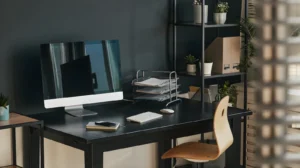
A moody home office leans into drama: dark walls, low warm lighting, deep tones, and a cocooning atmosphere that blocks out the outside world. It’s different from dark academia in that it’s more modern, less traditional—think matte black surfaces, charcoal textiles, and ambient backlighting. This aesthetic works beautifully for evening workers, creatives, and anyone who finds bright, white spaces distracting rather than calming.
- Color palette: Charcoal, matte black, deep navy, warm grey, with small accents in rust, burgundy, or aged brass.
- Key furniture: A black or very dark desk (wood or matte laminate), a black mesh or dark fabric ergonomic chair, dark metal shelving, and a media console or closed cabinet for storage.
- Decor & accessories: Abstract dark-toned art, a single dramatic plant like a rubber tree or ZZ plant, matte black desk accessories, textured dark throw, moody candles (unlit, for texture).
- Lighting: LED strip backlighting behind the monitor or desk, a matte black desk lamp with a warm bulb, ambient wall sconces, or a floor lamp with a dark shade. Layered lighting is critical here to avoid a cave-like feel.
- Best for: Graphic designers, video editors, developers, musicians—creative night owls, and anyone who focuses better in enveloping, low-light environments.
Coastal / Light & Airy Aesthetic
If you want your workspace to feel like a permanent exhale, the coastal aesthetic delivers. It’s defined by natural light, soft blues and sandy neutrals, organic textures like rattan and jute, and a breezy openness that makes even small rooms feel spacious. You don’t need to live by the ocean—this look works anywhere you have decent daylight and a desire for optimism in your workday.
- Color palette: Crisp white, soft sky blue, sandy beige, driftwood grey, with accents in sea glass green or warm coral.
- Key furniture: A white or whitewashed wood desk, a rattan or light cane desk chair (add a seat cushion for comfort), open white shelving, woven baskets for storage.
- Decor & accessories: Ocean-inspired art or photography, a woven jute rug, coral or shells as subtle accents, a potted palm or air plants, linen curtains, a textured ceramic vase.
- Lighting: Maximize natural light with sheer white curtains. Add a rattan or woven pendant light and a simple white ceramic desk lamp with a warm-white bulb.
- Best for: Communicators, coaches, sales roles, community managers—collaborative, high-energy work that benefits from a bright, uplifting backdrop (and a great video call background).
Cottagecore / Cozy Aesthetic
The cozy home office aesthetic wraps you in warmth—soft textures, warm wood, gentle patterns, and the feeling of a favorite reading nook that happens to have Wi-Fi. Cottagecore offices are rich in personal touches: dried flowers, vintage finds, handmade pottery, and layered textiles. This style is perfect if you want your office to feel more like a room you love spending time in than a place you “have to” work.
- Color palette: Warm cream, soft sage, dusty rose, honey wood tones, with accents in lavender or muted mustard.
- Key furniture: A vintage or vintage-style wooden desk (a thrift find works perfectly), a cushioned armchair or upholstered desk chair with a soft fabric, an open wood bookshelf, and a small side table for your tea.
- Decor & accessories: Dried flower arrangements, a crocheted or knitted throw, vintage picture frames, a stack of well-loved books, potted herbs like lavender or rosemary on the windowsill, a linen table runner across the desk.
- Lighting: A vintage-style table lamp with a fabric shade, fairy lights strung along a shelf (used sparingly), warm-white bulbs, and natural light through floral or linen curtains.
- Best for: Freelancers, writers, therapists, teachers—anyone who values warmth and comfort and does their best work when they feel genuinely at ease.
Industrial / Loft Aesthetic
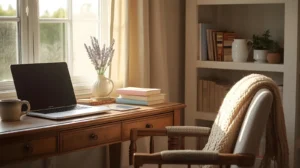
The industrial aesthetic borrows from converted warehouses and loft apartments: exposed materials, metal and wood combinations, and a no-nonsense functionality that still looks incredibly intentional. It has a raw, urban edge but remains warm when balanced with wood tones and a few soft textiles. This style suits people who prefer their workspace to feel strong and grounded rather than delicate.
- Color palette: Warm grey, matte black, raw wood (reclaimed oak or pine), exposed brick tones, with accents in aged copper or dark olive.
- Key furniture: A desk with a reclaimed wood top and black metal legs, a black or dark brown leather desk chair, metal pipe shelving or an industrial bookcase, a rolling metal cart for supplies.
- Decor & accessories: Metal wire baskets for storage, a vintage clock, blueprint-style or typographic art, a sturdy snake plant or monstera, an Edison-bulb desk lamp, a concrete or metal pen holder.
- Lighting: A metal-and-wood desk lamp, Edison-style warm bulbs, a metal pendant light, and clip-on work lights if needed for task lighting.
- Best for: Developers, engineers, architects, makers—work that benefits from a functional, distraction-free environment with character.
Maximalist / Eclectic Aesthetic
Maximalism is for the people who tried minimalism and felt their souls leaving their bodies. An eclectic home office is layered, colorful, deeply personal, and full of things that spark joy and inspiration. The key is intentional abundance—it should feel curated, not chaotic. Gallery walls, bold pattern mixing, collected objects from travels, and unexpected color combinations all live here. If your creative process feeds on visual stimulation, this is your aesthetic.
- Color palette: Choose a grounding base (deep teal, rich plum, warm terracotta, or even black) and then layer in 3–5 complementary bold accents—jewel tones, mustard, fuchsia, emerald. The base prevents visual chaos.
- Key furniture: A statement desk (painted, vintage, or a bold modern shape), a velvet or patterned upholstered chair, a large bookcase that serves as the room’s centerpiece, and a patterned rug.
- Decor & accessories: A salon-style gallery wall, collected objects and travel souvenirs, stacks of art books, patterned throw pillows, multiple plants of different sizes, colorful desk accessories, patterned curtains, or a bold wallpaper accent wall.
- Lighting: A sculptural or colorful desk lamp, a beaded or fringed pendant, fairy lights for whimsy, and warm bulbs throughout.
- Best for: Artists, brand designers, content creators, entrepreneurs—anyone who does their most creative work when surrounded by color, pattern, and personality.
Aesthetic Home Office Ideas by Room Size & Layout
Not everyone has a spare room to dedicate to their workspace, and that’s completely fine. Some of the most beautiful home office setups on the internet are tucked into bedroom corners, squeezed into living room alcoves, or carved out of studio apartments. The key is matching your aesthetic vision to your actual square footage and layout.
Small Space & Corner Offices
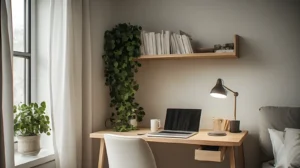
If you’re working from a bedroom corner, living room nook, or tiny spare room, every centimeter matters. Start with a wall-mounted desk or a narrow desk no wider than 120 centimeters (48 inches)—this gives you enough surface for a laptop, a lamp, and a small plant without overwhelming the room. Pair it with floating shelves above the desk instead of a bulky bookcase. Vertical storage is your best friend in small spaces.
Visual separation is just as important as physical furniture when your office shares a room with your bed or sofa. A simple curtain on a ceiling-mounted track, a slim open bookcase used as a room divider, or even a distinct rug under the desk area can signal to your brain that “this is the work zone.” This trick helps you mentally switch on and off, which is crucial when your commute is three steps. For more strategies on furnishing tight layouts, our guide to space-saving furniture ideas has detailed recommendations. If you’re in a studio, check out our studio apartment decor ideas for women for layout inspiration that integrates an office naturally.
A strong small-space setup could look like this: a 120-centimeter wall-mounted desk in light wood, two floating shelves above it styled with a few books, a trailing plant, and one framed print, a compact upholstered chair, and a single desk lamp. That’s it. It’s enough to create a fully aesthetic workspace that folds visually into the rest of the room.
Dedicated Room Home Offices
If you’re lucky enough to have a full room for your home office, you have the space to create zones—and zoning is what separates a great home office from a desk surrounded by random stuff. Think of three zones: a work zone centered on your desk and monitor, a thinking or reading zone with a comfortable chair and a small side table, and a storage zone with shelving, filing, and supplies tucked away neatly.
Use rugs to anchor each zone visually—a larger rug under the desk and chair area, and a smaller one under the reading chair. If you want to go further, painting one wall an accent color behind your desk creates a focal point and also gives you a polished video call background. According to Apartment Therapy’s 2025 design forecast, dedicated home offices are increasingly designed with this multi-zone approach, reflecting the reality that remote work involves more than just sitting at a desk.
Shared Spaces (Bedroom / Living Room)
When your office lives inside a bedroom or living room, the most important rule is color continuity. Your desk area should feel like part of the room, not an afterthought bolted onto it. Pull your office palette from the room’s existing colors—if your living room is warm neutrals, don’t introduce a neon pink desk setup. Choose an aesthetic that naturally complements the room’s vibe.
Visual separation still matters, though. An accent wall behind the desk (even a peel-and-stick wallpaper panel), a rug that defines the office footprint, or a slim curtain you can close at the end of the workday all create healthy boundaries. If your office is in your bedroom, this boundary is especially important for sleep hygiene—being able to “close” the office, even symbolically, helps your brain stop associating the bedroom with work. For bedroom-specific styling, our bedroom decor ideas for women guide has tips on balancing restful and functional design. If the office is in your living room, check out our living room decor ideas for women for cohesive room-wide approaches.
The Aesthetic Desk Setup – Surface Styling Guide
Your desk surface is the thing you look at more than anything else during the workday. It deserves the same styling attention as a shelf or a coffee table—but with the constraint that everything on it needs to actually serve a purpose. Here’s how to make your aesthetic desk setup both beautiful and genuinely usable.
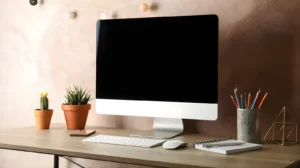
Start with your screen. If you use a monitor, place it on a stand or riser that elevates it to eye level. This is critical for your neck and posture, and it also creates a clean layer beneath the monitor—perfect for sliding a keyboard under at the end of the day. If you use a laptop, a laptop stand accomplishes the same thing. Choose a riser in a material that matches your aesthetic: light wood for Japandi, matte black for moody or industrial, marble-look for coastal, acrylic for minimalist.
Define a “daily items” zone. Instead of letting pens, notebooks, lip balm, and your phone scatter across the desk, corral them onto a small tray or in a single desk organizer. A ceramic tray, a brass dish, or a woven basket—depending on your aesthetic—keeps the essentials accessible but visually contained. This one change eliminates most desk clutter instantly.
Add one living element. A small plant on the desk brings life to the surface without eating up workspace. A four-inch pothos in a ceramic pot, a tiny succulent, or a single stem in a bud vase all work. Place it in a back corner or beside the monitor so it doesn’t crowd your active working area.
Choose your desk lamp intentionally. The lamp is often the most prominent decor object on a desk, so pick one that anchors the aesthetic. A slim brass lamp says dark academia. A matte white ceramic lamp says minimalist. A rattan-shaded lamp says coastal. It should provide good task lighting and look great when you glance at it.
Manage your cables ruthlessly. Nothing destroys an aesthetic desk setup faster than a tangle of cords. Use adhesive cable clips to route cords along the back edge of the desk, a cable tray mounted underneath to catch power strips and excess length, and cable sleeves to bundle everything into a single line from desk to outlet. A desk mat—felt, leather, or cork—can also hide where cables emerge and add a warm, finished look to the surface.
Aesthetic Home Office Lighting Ideas
Lighting can make or break a home office aesthetic. A room that’s beautifully furnished but badly lit will always look and feel off. The goal is layered lighting: three types working together to create depth, function, and atmosphere.
Ambient lighting provides overall illumination. This is your ceiling fixture, pendant, or floor lamp—whatever fills the room with a base level of light. Choose a fixture that matches your aesthetic (a paper lantern for Japandi, a metal cage pendant for industrial, a linen drum shade for minimalist) and opt for warm-white bulbs in the 2700–3000K range. Harsh cool-white overhead light makes any room feel like a waiting room.
Task lighting is your desk lamp. It should illuminate your keyboard and working area without creating glare on your screen. Position it on the opposite side from your dominant hand to minimize shadows while writing. Adjustable-arm lamps give you the most flexibility.
Accent lighting adds mood and depth. This is where aesthetics get really fun. LED strip lights behind a monitor create a cinematic glow for moody and dark setups. A small table lamp on a shelf adds warmth to a reading nook. Battery-operated puck lights inside a bookcase highlight your styled shelves. These aren’t essential for seeing—they’re essential for feeling.
Natural light deserves its own mention. Position your desk near a window whenever possible, ideally with the window to the side of your monitor rather than directly behind it. Side lighting is flattering for video calls and reduces screen glare. If your window is behind your desk, you’ll appear as a silhouette on camera—solvable with sheer curtains to diffuse the light and a ring light or desk lamp aimed at your face.
For video calls specifically, the simplest rule is this: light should come from in front of your face, not behind it. A desk lamp positioned just behind your monitor or a ring light clipped to the top of your screen provides soft, flattering front-facing light. Avoid relying solely on harsh overhead lighting, which creates unflattering shadows under the eyes and chin.
Color Palette Guide for Aesthetic Home Offices
Color is one of the most powerful tools in home office design, and getting it right doesn’t require a design degree—it requires a plan. A quick primer on color psychology: blues and greens are consistently linked to improved focus and a sense of calm, making them strong choices for walls or accents in a workspace. Warm neutrals (cream, taupe, beige) promote comfort and reduce visual tension. Bold, saturated colors—mustard, terracotta, deep plum—are best used as accents that energize without overwhelming.
The simplest approach is the 60-30-10 rule. Choose your main color (walls, largest surfaces) for 60% of the room, a secondary color (furniture, textiles) for 30%, and an accent color (decor, accessories) for 10%. This creates balance automatically and prevents any one color from dominating or clashing.
Here are five palette recipes you can apply directly, each mapped to the aesthetics they suit best:
- “Soft Japandi” — Warm white, mushroom, taupe, charcoal details. Suits Japandi and minimalist aesthetics. Feels grounded, calm, and warm without any single bold color.
- “Dark Academia Study” — Deep forest green, mahogany, cream, aged brass. Suits dark academia and moody aesthetics. Rich and intellectual, with a strong contrast between dark and light elements.
- “Coastal Calm” — Crisp white, soft blue, sandy beige, driftwood grey. Suits coastal and light-and-airy aesthetics. Bright, optimistic, and spacious-feeling even in smaller rooms.
- “Cozy Blush” — Warm cream, dusty rose, sage green, honey wood. Suits cottagecore and cozy aesthetics. Soft, romantic, and inviting without feeling juvenile.
- “Urban Edge” — Warm grey, matte black, raw wood, copper accents. Suits industrial and moody aesthetics. Modern, strong, and visually grounded.
When choosing your palette, test colors in your actual room before committing. Paint two or three large swatches on the wall and observe them at different times of day—a color that looks perfect in morning light might feel completely different under evening artificial light. This ten-minute test saves hours of repainting.
Your Home Office Background for Video Calls
Your Zoom or Teams background has become part of your professional presence. Whether you’re meeting clients, collaborating with colleagues, or hopping on a podcast, the rectangle visible behind your head communicates something—and you get to decide what it says. Think of it as part of your personal brand, not an afterthought.
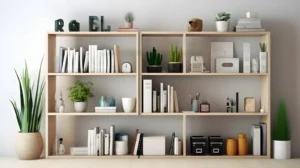
The most universally polished background is a styled bookshelf. The key is balance: alternate between vertical and horizontal book stacks, intersperse small decor objects (a ceramic vase, a framed photo, a small sculpture), and add one or two trailing or upright plants. Avoid stuffing every inch—leave some breathing room. The goal is curated, not crammed. Our guide to wall decor ideas has plenty of gallery-wall and shelf-styling tips that translate directly to video call backgrounds.
If you don’t have bookshelves behind you, a simple composed vignette works just as well. A piece of art flanked by a tall plant on one side and a table lamp on the other creates depth and visual interest without clutter. Two to three framed prints arranged in a clean gallery formation on the wall behind you also reads beautifully on camera. Even a single large-scale piece of art—abstract, botanical, or photographic—gives your background a finished, intentional quality.
A few things to avoid: a completely blank wall (reads as empty and unfinished on camera), a visible bed (undermines professionalism, even in casual remote cultures), reflective surfaces that create glare or visual chaos, and overly busy or cluttered shelves that compete with your face for attention. If your room is unavoidably messy behind you, a folding screen or tall plant positioned strategically can block the problem areas without requiring a full redesign.
One practical note: test your background before your next important call. Open your camera app, sit in your desk chair, and look at what’s visible in the frame. Adjust anything that looks unbalanced, distracting, or unintentional. Five minutes of styling can change how you’re perceived for months.
Aesthetic Home Office Ideas by Budget
An aesthetic workspace doesn’t require a massive budget—it requires intention. Whether you’re spending under $300 or over $1,000, the principles are the same: choose a clear style, invest in the pieces that matter most, and let a few well-chosen details do the heavy lifting.
Under $300 – Starter Aesthetic Office
At this budget, your money goes furthest at IKEA, thrift stores, and budget home-goods retailers. For the desk, the IKEA LAGKAPTEN tabletop on ADILS legs or the classic ALEX drawer unit gives you a clean, functional surface for well under $100. Pair it with the most comfortable chair you can afford—even a basic task chair with a cushion and a throw draped over the back looks pulled-together.
With the remaining budget, focus on these high-impact, low-cost additions: one desk lamp (IKEA has great options under $30), one to two small plants (a pothos cutting in a ceramic pot costs almost nothing), a desk mat or mouse pad in a material that fits your aesthetic, basic cable management clips, and one piece of wall art or a framed print from a digital download shop. This is the IKEA home office aesthetic at its best—simple, functional pieces elevated by a few intentional styling choices. For more ideas on making small budgets work in tight spaces, our small apartment decor ideas for women guide covers budget-friendly approaches in detail.
$300–$1,000 – Elevated Aesthetic Office
This is where your home office starts to feel truly styled. Allocate roughly 40% to a better desk (solid wood, a larger surface, or a standing desk converter), 25% to an upgraded chair (something ergonomic that also looks good—mid-range brands offer plenty of options with clean silhouettes), and the remaining 35% to lighting, a rug, wall decor, and accessories.
A well-chosen rug under your desk anchors the entire space and adds warmth and texture instantly. Better lighting—a proper desk lamp and a floor lamp or pendant—transforms how the room feels at every hour. Wall decor goes from one print to a small gallery arrangement or a statement piece. At this level, your office looks intentional and feels comfortable for long workdays.
$1,000+ – Premium Aesthetic Office
With a four-figure budget, you can invest in pieces that last and elevate every detail. A real wood desk—walnut, oak, or reclaimed timber—becomes the room’s centerpiece and will look better with age. A high-end ergonomic chair (from brands known for both support and design) means you never have to choose between looking good and sitting well.
This tier also opens up built-in shelving, custom paneling or paint treatments, high-quality art (original prints, not just downloads), premium lighting fixtures, and custom organizational systems. The key is not to spend everywhere at once—invest in the desk and chair first, then layer in everything else over time. Even at this budget, the most beautiful offices often have the most restraint.
Biophilic Touches That Work in Any Aesthetic
No matter which aesthetic you’ve chosen, adding natural elements makes your office feel more alive, more grounded, and—according to a growing body of research, including studies published in the International Journal of Environmental Research and Public Health—more conducive to creative thinking and stress reduction. Biophilic design is simply the practice of bringing nature indoors, and it’s one of the easiest ways to elevate any workspace.
Plants are the most obvious starting point, and the best office plants are the ones that tolerate neglect. Pothos, snake plants, ZZ plants, and peace lilies all thrive in indirect light and forgive inconsistent watering. If your office gets almost no natural light, a high-quality faux plant is a perfectly valid choice—the visual benefit of greenery still applies. For your desk, stick to small four- to six-inch pots. For the floor or a shelf, a larger plant in a basket or ceramic planter adds instant life.
Beyond plants, natural materials carry biophilic energy throughout the room. A wood desk (or wood desk accessories), linen curtains, a jute or wool rug, stone coasters, a rattan lamp shade, or a ceramic vase—these textures connect you to the natural world even in an urban apartment with no view of a single tree. And if you have a window, maximize it: let in as much daylight as possible, and orient your desk so you can glance out periodically. Even brief visual access to the outdoors reduces mental fatigue.
For dark or windowless rooms, combine warm lighting with natural materials and at least one statement plant (real or faux). A The Spruce’s guide to low-light indoor plants is a solid resource for choosing species that’ll actually survive in dim corners.
FAQ – Aesthetic Home Office Ideas
What is the most popular aesthetic home office style in 2026?
Japandi continues to dominate in 2026, blending the warmth of Japanese wabi-sabi with Scandinavian simplicity. It resonates because it feels calm without being cold—natural wood, handmade textures, and a muted palette that works in both large and small spaces. Dark academia remains a strong second, especially on Pinterest and TikTok, while cozy or cottagecore offices have grown steadily among women who want warmth and personality in their workspace.
How do I make my home office look aesthetic on a budget?
Start with three high-impact, low-cost changes: a desk lamp that fits your chosen style, one or two small plants, and a piece of wall art (even a framed digital print). Add a desk mat to unify your surface and use cable management clips to hide cords. Thrift stores are excellent sources for desk accessories, frames, and even small furniture. You can create a genuinely aesthetic workspace for under $300 by focusing on intention rather than expense.
How do I create an aesthetic home office in a small bedroom corner?
Choose a wall-mounted or narrow desk (120 centimeters or less) so it doesn’t overwhelm the room. Mount two floating shelves above it for storage and decor. Keep the color palette consistent with the rest of the bedroom so the desk area feels integrated, not tacked on. A small rug under the chair and a desk lamp define the workspace visually. If possible, use a curtain or small screen to separate the office corner from the sleeping area—this helps your brain shift between work and rest modes.
What colors work best for an aesthetic home office?
Blues and greens promote focus and calm—ideal for deep-concentration work. Warm neutrals like cream, taupe, and mushroom create comfort without distraction. If you want energy, introduce bold accents like terracotta, mustard, or deep plum in small doses (desk accessories, a throw, a piece of art) rather than painting entire walls. The 60-30-10 rule (60% dominant neutral, 30% secondary color, 10% accent) creates a balanced, cohesive palette in any aesthetic.
How can I style my desk to look aesthetic but still be practical?
Keep only what you use daily on the surface and corral small items into a tray or single organizer. Use a monitor stand or laptop riser to create a clean visual layer. Add one small plant and one well-chosen desk lamp. Hide cables with adhesive clips and a cable tray. A desk mat ties the surface together. The goal is “everything visible is intentional”—if it’s not beautiful or functional, store it in a drawer.
What plants are best for an aesthetic home office?
Pothos, snake plants, and ZZ plants are the gold standard for offices—they tolerate low light, irregular watering, and still look beautiful. Trailing pothos looks wonderful on a shelf or desk corner. Snake plants add sculptural height. Peace lilies contribute soft greenery and occasional white blooms. For desks, small four-inch pots work best. For floors or shelves, go larger. If your space is very dark, high-quality faux plants are a perfectly good option.
How do I make my background look good on Zoom or Teams?
The easiest approach is a styled bookshelf: alternate vertical and horizontal books, add a plant, a vase, and a framed print, and leave some space. If you don’t have shelves, hang two to three framed prints or one statement piece on the wall behind you. Place a tall plant or a lamp to one side for depth. Make sure light falls on your face (a lamp behind the monitor works well) rather than behind you. Avoid blank walls, visible beds, and cluttered surfaces in the frame.
Can I mix two home office aesthetics?
Absolutely—many of the best offices blend elements from two complementary styles. Japandi and minimalist pair naturally. Dark academia and cozy share warmth and texture. Industrial and moody both use dark tones and raw materials. The key is to pick a primary style (about 70–80% of the room) and borrow accents from a secondary one. Avoid mixing styles that pull in opposite directions, like stark minimalism with full maximalism, as the room will feel confused rather than curated.
How do I make a dark aesthetic office feel warm and not gloomy?
Layered lighting is everything. A dark room with only one overhead light will feel like a cave, but the same room with a warm desk lamp, LED backlighting behind the monitor, and a floor lamp in the corner feels cocooning and intentional. Use warm-toned bulbs (2200–2700K), add at least one plant for life, and incorporate warm textures—a rust or cognac leather accent, a wood element, or a soft throw. Warm materials prevent dark colors from feeling flat or cold.
What desk shape works best for a small aesthetic home office?
A simple rectangular desk between 100 and 120 centimeters wide is the most versatile choice for small spaces. It’s wide enough for a laptop or monitor, a lamp, and a small plant, but narrow enough to fit into a corner or against a wall without dominating the room. Wall-mounted desks and fold-down desks save even more floor space. Avoid L-shaped desks in small rooms—they eat up corner space and make the room feel crowded. A clean, slim desk lets the room breathe.
Conclusion
Your home office is the room where you spend most of your productive hours. It deserves to be a space that looks as good as your work feels—not because aesthetics are frivolous, but because beauty and function support each other. A calm, intentional, well-lit workspace genuinely helps you focus, feel better, and show up with more energy every day.
You don’t need to overhaul everything at once. Start by choosing one aesthetic direction that resonates with how you work and how you want to feel. Pick one budget tier that’s realistic right now. Then make two or three changes: upgrade your desk lamp, style the wall behind your chair, add a plant, and manage your cables. These small, intentional moves add up fast—and they’ll change how every workday feels.
For more inspiration as you build out your space, explore our home office design resources, our complete guide to wall decor ideas for styling your walls and video backgrounds, and our space-saving furniture ideas for making the most of compact layouts. If your office shares a room with your living space, our living room decor ideas for women and bedroom decor ideas for women guides will help you integrate everything beautifully. Your workspace should look as good as your work deserves—and now you have everything you need to make that happen.