

Introduction
The average American apartment has been quietly shrinking for years. According to RentCafe, newly built apartments average around 1,000 square feet nationally, and in cities like New York, Seattle, and San Francisco, studios regularly clock in well under 500. Layer on rising rents, the lasting reality of working from home, and the desire for a space that actually feels like yours — not a college dorm sequel — and you start to understand why space-saving furniture ideas have become one of the most searched home topics heading into 2026.
This guide is built for you if you are furnishing your first solo apartment, wrestling with a studio layout that has to function as a bedroom, living room, and office all at once, or simply tired of bumping your hip on furniture that is too big for your floor plan. Everything here is practical, specific, and organized so you can use it two ways: scan by room if you have one problem area to solve, or read end to end if you are starting from scratch and want a full strategy.
Here is what you will find inside: room-by-room furniture ideas covering the living room, bedroom, home office, kitchen, dining area, kids’ room, bathroom, and entryway — 50 ideas in total. Every idea includes a quick explanation of why it works, layout or sizing tips, an honest pros-and-cons snapshot, and a realistic budget range. After the room sections, you will find a list of common mistakes, a budget guide broken into three tiers, and an FAQ that answers the real questions people ask before they buy.
One important note: every idea is flagged as renter-friendly (no drilling, no permanent changes) or owner/committed-renter (requires wall mounting or minor modifications). If you are renting and your lease says no holes, you will still find dozens of options here.
Let’s start with the thinking behind every great small-space furniture choice.
The 5 Design Principles Behind Every Space‑Saving Furniture Choice
Before you add a single piece to your cart, these five principles will save you from costly mistakes and help you build a room that feels twice its actual size.
1. Multi‑Functionality First
In a small space, every piece of furniture needs to pull double duty — or it does not earn its square footage. A coffee table that also stores blankets and remotes, a dining table that converts into a desk, or a bed frame with built-in drawers: these are the workhorses of compact living. Before you buy anything, ask yourself: “Does this do at least two jobs?” If the answer is no, look for the version that does.
2. Vertical Space Utilization
Floor space is finite. Wall space, on the other hand, is almost always underused. Floating shelves, wall-mounted nightstands, tall, narrow bookcases, and over-door organizers move storage off the floor and draw the eye upward, which makes a room feel taller. A good rule of thumb: if you have run out of floor, look up.
3. Visual Weight and Transparency
Two pieces of furniture can occupy the same physical dimensions and feel completely different in a room. A solid oak cube side table feels heavy; an acrylic one almost disappears. Furniture with slim legs, open bases, glass or acrylic surfaces, and light colors carries less “visual weight,” which keeps a small room from feeling stuffed. This does not mean everything has to be see-through — just be intentional about mixing a few visually light pieces with your heavier ones.
4. Negative Space as a Design Element
It is tempting to fill every corner, but breathing room is what separates a small space that feels cozy from one that feels cramped. Leave some wall area empty. Let the floor show between furniture groupings. Negative space is not wasted space — it is what makes a 400-square-foot apartment feel livable rather than like a storage unit.
5. Furniture Sizing and Measuring
This one sounds obvious, but it is the number-one reason people end up returning furniture or living with pieces that overwhelm their rooms. Before you shop, measure three things: the spot where the furniture will live (length, width, and height clearance), the path from your front door to that spot (hallways, doorways, stairwells), and the circulation clearance you need around it. For walkways, aim for at least 30 to 36 inches of clear passage — the OSHA Computer Workstations eTool recommends similar clearances for desk setups to maintain healthy ergonomics. For dining chairs, you need roughly 36 inches from the table edge to the nearest wall so chairs can be pulled out comfortably. Write these numbers down before you open a single shopping tab.
Living Room — 10 Space‑Saving Furniture Ideas
The living room is usually the first space guests see and the room where you spend the most waking hours, so it needs to work hard without looking like it is trying. These ten ideas cover seating, surfaces, storage, and display — everything a small living room needs.
1. Modular or Sectional Sofas for Small Living Rooms
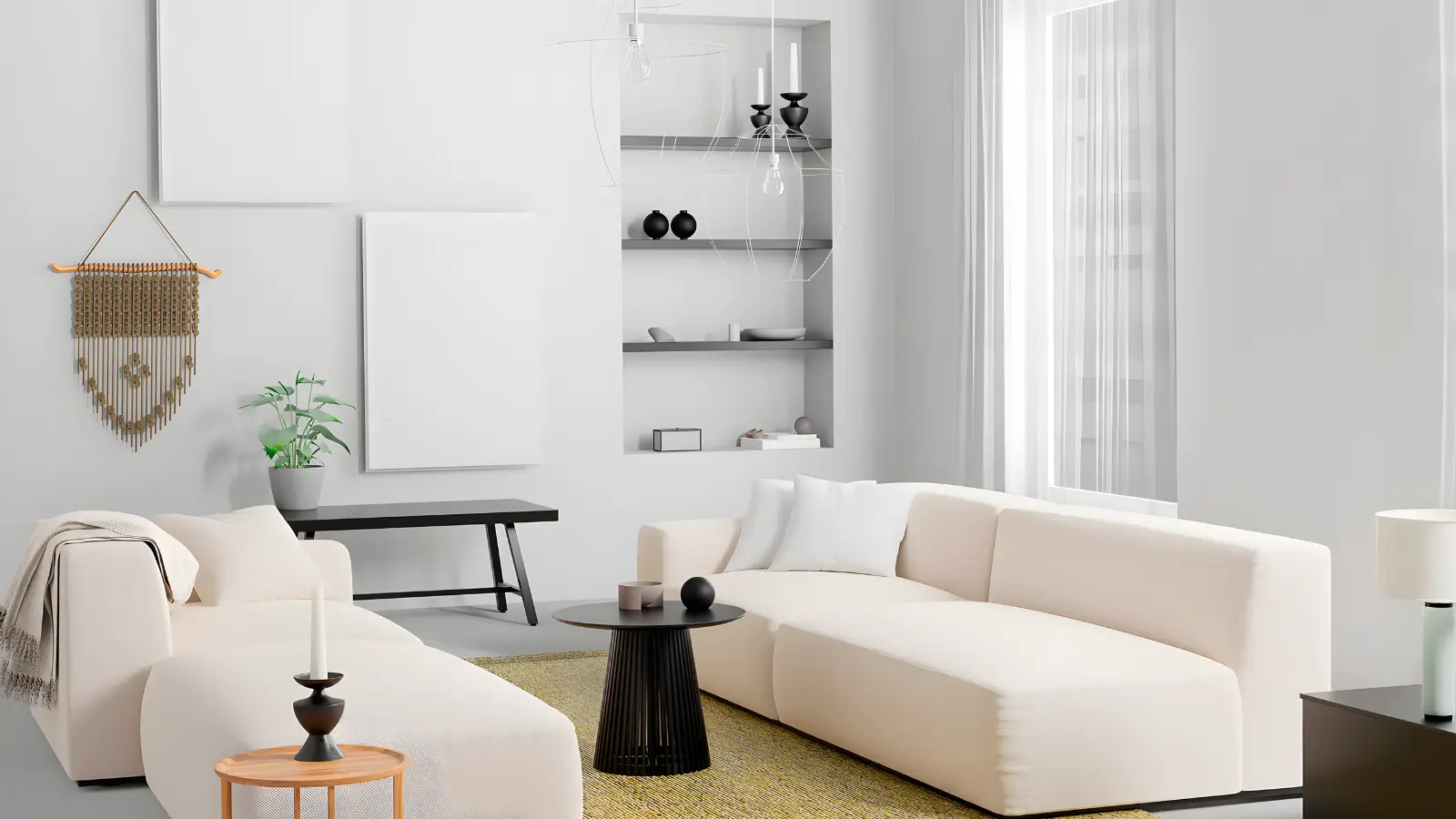
A modular sofa is made of individual pieces — typically a corner unit, armless sections, and an ottoman — that you can rearrange, separate, or add to over time. For small spaces, this matters because you can start with a two-piece configuration that fits your current apartment and expand later if you move somewhere bigger. Look for models with a total width under 80 inches and a depth of 33 inches or less,s so the sofa does not swallow the room. Many modular designs also offer hidden storage inside the ottoman section.
Pros: Flexible configuration, easy to move through narrow doorways as separate pieces.
Cons: Quality varies widely; very cheap modular sofas can feel unstable at the seams.
Budget range: $400–$1,500.
If you are working with an especially tight living room, our guide to Small Apartment Decor Ideas for Women covers layout strategies that pair well with compact seating.
2. Sofa Beds and Pull‑Out Couches
If your living room doubles as a guest room — or is your bedroom — a sofa bed eliminates the need for a separate sleep surface. The category has improved dramatically over the past few years; you can now find pull-out mechanisms that do not feel like sleeping on a metal bar and futon-style options that fold flat without a visible mattress seam. Size tip: a full-size pull-out (54 inches wide when open) fits most studio layouts better than a queen, which needs significant clearance in front.
Pros: Eliminates the need for a separate bed or guest mattress.
Cons: Even the best pull-outs are a compromise on sleep comfort for nightly use.
Budget range: $350–$1,200. Renter-friendly: Yes.
3. Nesting Coffee and Side Tables
Nesting tables — two or three tables that tuck inside one another — give you surface area when you need it and take up the footprint of a single table when you do not. Pull them out for hosting, then stack them back together on a Tuesday night. Choose a set where the smallest table can also function as a side table beside the sofa to get even more flexibility.
Pros: Expandable surface area, visually compact when stacked.
Cons: Not ideal if you need permanent storage inside a coffee table.
Budget range: $80–$400.
4. Lift‑Top Coffee Tables with Hidden Storage
A lift-top coffee table looks like a standard table until you raise the top, which comes up to a comfortable height for eating or working on a laptop, revealing a storage compartment underneath. This is one of the best multi-functional furniture picks for studio apartments because it replaces a coffee table, a small dining table, and a storage bin in a single piece. Look for models with casters if you plan to roll it out of the way.
Pros: Eating/working surface plus hidden storage in one compact footprint.
Cons: Lift mechanisms can wear out on cheaper models.
Budget range: $120–$500.
5. Wall‑Mounted TV Units Instead of Bulky Media Consoles
A traditional media console can be 18 to 24 inches deep, eating into your walkway. Mounting the TV on the wall and adding a slim floating shelf or a wall-mounted media unit underneath reclaims all that floor space instantly. If your lease does not allow drilling, a slim TV stand with a depth of 12 inches or less, or a floor-to-ceiling tension pole TV mount, achieves a similar effect without touching the walls.
Pros: Frees significant floor space, cleaner sightlines.
Cons: Wall mounting requires drilling (owner or committed-renter solution); cord management needs planning.
Budget range: $50–$300 for wall mount and floating shelf; $80–$250 for slim no-drill alternatives.
6. Storage Ottomans and Benches
A storage ottoman works as a footrest, extra seating when guests visit, and a hidden compartment for throw blankets, magazines, or anything else you want out of sight. A storage bench placed against a wall can replace a side table and a blanket basket at the same time. Choose upholstered options in a fabric that matches or complements your sofa to keep the room visually cohesive rather than cluttered with mismatched pieces.
Pros: Hidden storage, flexible seating, no assembly stress.
Cons: Interiors can become a “junk drawer” without organizers.
Budget range: $50–$300.
Renter-friendly: Yes.
7. Transparent or Acrylic Pieces
An acrylic coffee table, a glass-top side table, or a set of clear stacking chairs takes up physical space without taking up visual space. In a small living room, even one transparent piece can make the floor plan feel more open. This works especially well when paired with a heavier anchor piece like a fabric sofa — the contrast keeps the room from feeling like a furniture showroom.
Pros: Near-invisible visual footprint, modern aesthetic.
Cons: Shows dust and fingerprints easily; acrylic can scratch.
Budget range: $60–$500.
8. Slim Console Tables Behind the Sofa
If your sofa floats in the middle of the room — common in studios where the couch divides the sleeping area from the living area — a slim console table behind it defines the boundary and provides a surface for lamps, keys, or decorative objects without adding bulk. Look for models that are 10 to 12 inches deep and no taller than the sofa back.
Pros: Adds surface and room definition without taking up meaningful floor space.
Cons: Limited to narrow items; cannot support heavy objects on very slim models.
Budget range: $60–$250.
Renter-friendly: Yes.
9. Corner Shelving Units
Corners are the most wasted real estate in small apartments. A corner shelf unit — either a freestanding triangular bookcase or a set of floating corner shelves — turns a dead zone into display and storage space. Floor-to-ceiling designs maximize vertical storage. If you cannot drill, look for tension-rod corner shelving systems that press between the floor and ceiling.
Pros: Uses otherwise dead space, draws the eye upward.
Cons: Can collect clutter if you don’t curate what goes on them.
Budget range: $30–$200.
10. Folding or Stackable Accent Chairs
Keeping two to four folding chairs in a closet means you are always ready for guests without permanently dedicating floor space to extra seating. Modern folding chairs no longer look like picnic leftovers — you can find upholstered folding side chairs, woven rattan stackables, and powder-coated metal options that look intentional. Store them behind a door, inside a closet, or flat against a wall with a wall-mounted hook.
Pros: Guest seating on demand, stored flat when not in use.
Cons: Not as comfortable for long sitting as a full armchair.
Budget range: $30–$150 per chair.
Renter-friendly: Yes.
Bedroom — 10 Space‑Saving Furniture Ideas
The bedroom is where space-saving furniture makes the most dramatic difference, because the bed itself is the single largest piece of furniture most people own. These ten ideas tackle the bed, the nightstand, the wardrobe, and all the small storage needs in between. For full decorating strategies, see our companion guides to Small Bedroom Ideas for Women and Bedroom Decor Ideas for Women.
11. Murphy Beds and Wall Beds for Micro Bedrooms
A Murphy bed folds up vertically into a wall cabinet, freeing the entire footprint of a queen mattress — roughly 40 square feet — when the bed is stowed. Modern Murphy beds include built-in shelving, lighting, or a fold-down desk on the front panel so the wall does double duty day and night. This is the single highest-impact space-saving piece you can buy for a studio, but it does require wall mounting into studs, making it an owner or committed-renter solution.
Pros: Reclaims the largest furniture footprint in any home, and can include a desk or shelving.
Cons: Requires professional installation and stud-mounted hardware; not suitable for casual renters; higher price point.
Budget range: $800–$3,000+, depending on mechanism quality and built-in features.
12. Storage Bed Frames with Drawers or Lift Storage
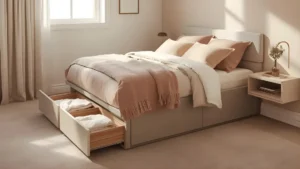
If a Murphy bed is too big an investment, a storage bed frame delivers serious hidden capacity with zero installation. Drawer-style frames have two to four pull-out drawers on the sides, while hydraulic lift frames raise the entire mattress platform on gas struts, revealing a full-footprint storage bay underneath. The lift style holds more but needs clearance above the mattress area to raise it. Either version can replace a dresser entirely in a very small bedroom.
Pros: Massive hidden storage, can eliminate the need for a separate dresser.
Cons: Heavier than standard frames; lift versions need ceiling clearance.
Budget range: $250–$900.
Renter-friendly: Yes.
13. Loft Beds with Desk or Wardrobe Underneath
A loft bed raises the sleeping surface to near-ceiling height and opens the floor underneath for a desk, a small sofa, a wardrobe, or all three. This is one of the most efficient furniture-for-small-spaces solutions for studios under 300 square feet. Ceiling height matters: you need at least eight feet to sit up comfortably in a lofted bed. Measure the distance from the floor to the ceiling, then subtract the mattress thickness and at least 30 inches of sitting clearance above it.
Pros: Essentially doubles usable floor space.
Cons: Climbing in and out can be inconvenient; not ideal if you dislike heights or have mobility concerns.
Budget range: $200–$800.
Renter-friendly: Freestanding versions, yes.
14. Daybeds That Convert from Sofa to Guest Bed
A daybed works as a sofa by day and a twin or full bed by night, which makes it a natural fit for multi-purpose rooms. Trundle versions pull out a second mattress from underneath for guests sleeping without taking any extra permanent floor space. Style tip: dress it with bolster pillows along the back wall so it reads as a sofa during the day rather than an unmade bed.
Pros: Dual sofa/bed function, trundle option adds a guest bed.
Cons: Narrower than a standard bed; mattress choice is limited by frame depth.
Budget range: $200–$700.
Renter-friendly: Yes.
15. Under‑Bed Rolling Drawers and Boxes
If you already own a bed frame with clearance underneath, rolling drawer bins, or vacuum storage bags, turn that dead space into a full storage zone for off-season clothes, shoes, or extra linens. Low-profile rolling drawers (about 6 inches tall) fit under most standard frames. Measure the gap between your floor and the bottom of the bed rail before buying.
Pros: Extremely affordable, no modification to existing furniture.
Cons: Requires bending down to access; dust can accumulate.
Budget range: $15–$60 for a set.
Renter-friendly: Yes.
16. Floating Nightstands and Wall‑Mounted Lamps
A floating nightstand — a small shelf or drawer unit mounted to the wall beside the bed — frees the floor space a traditional nightstand would occupy. Pair it with a wall-mounted reading lamp or a plug-in sconce to eliminate the table lamp. The result is a cleaner floor line and easier vacuuming in a tight bedroom. If drilling is not an option, adhesive-mounted small shelves rated for the weight you need, or a bedside caddy (see idea 20), can substitute.
Pros: Opens floor space, modern and clean look.
Cons: Requires wall mounting (screws into studs recommended).
Budget range: $25–$150.
Owner / committed-renter solution for true floating shelves.
17. Narrow Wardrobes and Modular Closet Systems
Many small apartments come with inadequate closets — or none at all. A narrow freestanding wardrobe (16 to 20 inches deep instead of the standard 24) fits against a wall without jutting into the room. Modular closet systems from retailers like IKEA let you customize hanging rods, drawers, and shelves inside a slim frame. If you are working with an existing small closet, an internal organizer with double hanging rods and shelf dividers can nearly double its usable capacity.
Pros: Customizable, fits shallow walls, no built-in closet required.
Cons: Freestanding wardrobes should be anchored to the wall for safety (tip-over risk).
Budget range: $80–$600.
18. Over‑Door Hooks and Hanging Storage
The back of every door is free real estate. Over-door hooks hold bags, scarves, belts, and jackets. Over-door shoe organizers (the clear pocket kind) can hold shoes, cleaning supplies, accessories, or craft supplies — not just footwear. This is one of the simplest, most renter-friendly storage upgrades you can make, and it costs almost nothing.
Pros: Zero drilling, instantly adds storage, completely reversible.
Cons: Can rattle when the door opens/closes; heavy loads may scratch the door top.
Budget range: $8–$30.
Renter-friendly: Yes.
19. Folding Vanity Tables and Wall‑Mounted Mirrors
A folding vanity desk mounts to the wall and folds flat when you are not using it, leaving just a narrow panel against the wall. When open, it reveals a mirror, small shelves for cosmetics, and a surface for your routine. If wall mounting is not possible, a slim console table with a leaning mirror achieves a similar look and can be moved when you leave the apartment.
Pros: Dedicated vanity space without a permanent footprint.
Cons: Wall-mounted versions require installation; limited surface area.
Budget range: $60–$300.
20. Bedside Caddies for Ultra‑Small Rooms
When there truly is no room for any nightstand — not even a floating shelf — a bedside caddy slips between the mattress and the frame and hangs down the side, holding a phone, glasses, a book, and a remote. It is not glamorous, but it is functional, costs almost nothing, and keeps essentials within arm’s reach. Look for felt or canvas versions with stiffened pockets so they hold their shape.
Pros: Works in any bed configuration, zero footprint, extremely affordable.
Cons: Cannot hold heavy items; not as stable as a shelf or table.
Budget range: $8–$20.
Renter-friendly: Yes.
Home Office — 7 Space‑Saving Furniture Ideas
Working from home in a small apartment means the office has to appear when you need it and, ideally, disappear when you do not. These seven compact furniture ideas let you carve out a functional workspace even if you have zero dedicated office square footage. For more design inspiration, visit our Small Home Office Ideas guide.
21. Wall‑Mounted Fold‑Down Desks
A fold-down desk (sometimes called a floating desk or secretary desk) mounts to the wall and folds flat against it when not in use. Open, it provides enough surface for a laptop, notebook, and a coffee cup. Closed, it is just a slim cabinet or panel. Look for models at least 20 inches deep when open so your keyboard and screen have enough room. The OSHA Computer Workstations eTool recommends a desk depth that allows your forearms to rest comfortably at a roughly 90-degree angle while typing.
Pros: Full desk appears and disappears in seconds; clean look when closed.
Cons: Wall mounting required; limited desk depth compared to full-size desks.
Budget range: $80–$350.
Owner / committed-renter solution.
22. Murphy Desk and Shelving Combos
A step up from the basic fold-down desk, a Murphy desk combo integrates a folding work surface with built-in shelving or a small cabinet above and below. When the desk folds up, the shelves remain visible and functional — holding books, plants, or decor. This is an excellent investment piece for a studio where the “office” is in the living room because it looks intentional even when the desk is hidden.
Pros: Desk plus shelving in one wall-mounted unit, neat appearance.
Cons: More complex installation; higher cost than a simple fold-down.
Budget range: $200–$700.
23. Corner Desks for Awkward Corners
Corners collect dust or, worse, awkward floor lamps. A compact corner desk — especially an L-shaped model with a short return — turns a wasted angle into a legitimate workspace. Keep the total width of each side under 48 inches so it does not dominate the room. A corner desk also benefits from corner-mounted floating shelves above for supplies and books.
Pros: Uses otherwise dead space, creates a defined work zone.
Cons: Chair placement can feel cramped if corners are shallow.
Budget range: $80–$400.
Renter-friendly: Freestanding versions, yes.
24. Ladder Desks and Shelving
A ladder desk combines a leaning shelf unit with a small pull-out desk surface partway up. It leans against the wall (no mounting needed on most models) and takes up a footprint of only about 24 by 20 inches. The shelves above hold office supplies, and the compact desk surface is enough for a laptop.
Pros: Minimal footprint, no wall mounting, looks decorative.
Cons: Narrow work surface; not ideal for dual monitors or large projects.
Budget range: $70–$250.
Renter-friendly: Yes.
25. Compact File Cabinets and Mobile Pedestals
If you deal with paperwork — tax documents, leases, medical records — a slim two-drawer file cabinet on casters can slide under a desk or tuck into a closet. A mobile pedestal (the small rolling cabinet you see in traditional offices) serves the same purpose and can double as a printer stand or side table. Choose one that is the same height as your desk surface, so it extends your workspace when pulled alongside.
Pros: Organized paper storage, doubles as an extra surface or seating if topped with a cushion.
Cons: Easy to overstuff; paper accumulates fast.
Budget range: $40–$200.
Renter-friendly: Yes.
26. Dual‑Purpose Dining‑Table‑as‑Desk Solutions
If your apartment has a small dining table, there is a good chance it can function as your desk during the workday. The key is making the transition seamless: use a desktop organizer or caddy that holds your laptop, charger, and notebooks, then lifts off the table at mealtime. Pair the table with an ergonomic chair that also works for dining, or use a chair cushion that adds lumbar support to a standard dining chair.
Pros: Zero additional furniture needed, one table serves two functions.
Cons: Requires daily setup and teardown discipline; ergonomics may suffer without an adjustable chair.
Budget range: $0 (if you already own the table) to $150 for an organizer caddy and supportive cushion.
Renter-friendly: Yes.
27. Closet Office (“Cloffice”) Conversions
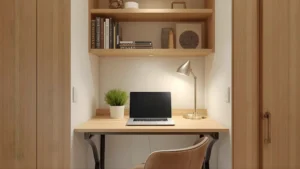
If you can spare a closet — even a shallow one — you can convert it into a fully enclosed office. Remove the closet doors (or replace them with curtains for a renter-friendly approach), install a shelf at desk height, add a task lamp and a small floating shelf above, and you have a workspace that vanishes behind a curtain at the end of the day. This is one of the best furniture for small spaces hacks for anyone who needs a visual boundary between work and rest.
Pros: Completely hidden when closed, dedicated workspace, excellent for video calls (clean background).
Cons: Sacrifices closet storage; may feel tight without good lighting and ventilation.
Budget range: $50–$400, depending on shelving and finishing.
Renter-friendly: Yes, if you use tension shelves and curtains instead of permanent modifications.
Kitchen & Dining — 7 Space‑Saving Furniture Ideas
Eating well in a small apartment starts with furniture that adapts to what you need: a table for two on weeknights that can seat four on Saturday, storage that does not require a full pantry, and seating that disappears when the cooking begins.
28. Drop‑Leaf and Extendable Dining Tables
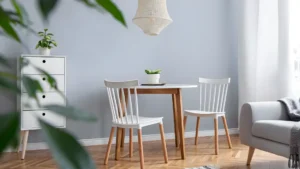
A drop-leaf table has hinged sides that fold down, cutting the table’s footprint in half (or more). Push it against the wall with both leaves down, and it functions as a slim console; pull it out and raise the leaves for a full dining surface. Extendable tables with a hidden center leaf offer a similar benefit in a different form. For small apartments, look for a drop-leaf model that measures 36 inches or less when folded.
Pros: Adjustable footprint, wall-hugging when minimized.
Cons: Drop-leaf supports can be fragile on low-cost models; seating at the folded side is limited.
Budget range: $100–$500.
Renter-friendly: Yes.
29. Wall‑Mounted Folding Tables
A wall-mounted folding table — sometimes called a “Murphy table” — works on the same principle as a fold-down desk but is sized and positioned for eating. Mount it at dining height (about 30 inches) in the kitchen or against an adjacent wall, and fold it flat after meals. Some models include a slim shelf on the back panel that remains functional when the table is stowed.
Pros: Near-zero footprint when folded, excellent for tight galley kitchens.
Cons: Requires wall mounting; seating is limited to stools or folding chairs that also store flat.
Budget range: $60–$250.
Owner / committed-renter solution.
30. Stackable or Folding Dining Chairs
Permanent dining chairs for four take up space 24 hours a day for a meal that lasts 30 minutes. Stackable or folding chairs solve this by storing vertically or flat against a wall. Modern options include bentwood stackables, metal café chairs, and upholstered folding chairs that look polished enough for a dinner party.
Pros: On-demand seating that stores compactly.
Cons: Less cushioned and comfortable for long meals than a full dining chair.
Budget range: $25–$120 per chair.
Renter-friendly: Yes.
31. Rolling Kitchen Islands with Storage
A small rolling island — typically 36 to 48 inches wide — adds counter space, storage (shelves, drawers, or cabinets below), and sometimes a butcher-block prep surface. Roll it into position when you are cooking, then push it against the wall or into a corner when you need floor space. Some models include a drop-leaf top for casual dining.
Pros: Mobile extra counter and storage, versatile placement.
Cons: Can feel crowded in very narrow galley kitchens.
Budget range: $100–$450.
Renter-friendly: Yes.
32. Bar Stools That Tuck Under the Counter
If your kitchen has an existing counter overhang or a breakfast bar, low-profile bar stools that tuck fully underneath free up walkway space when you are not eating. Choose stools with a slim profile and no armrests so they slide in completely. Backless stools tuck the farthest but sacrifice comfort; a low-back stool is a good middle ground.
Pros: Hidden when not in use, no table needed.
Cons: Only works if you have a counter overhang; backless versions lack support.
Budget range: $40–$180 per stool.
Renter-friendly: Yes.
33. Narrow Sideboards and Slim Storage Cabinets
A narrow sideboard — 10 to 14 inches deep — can hold dishes, table linens, pantry overflow, or small appliances without projecting far into the room. Position one along a hallway wall, behind a dining table, or in a gap between the kitchen and living area. This is a particularly smart move if your kitchen lacks cabinet space, but you have an unused stretch of wall nearby.
Pros: Significant storage in a slim profile, doubles as a serving surface.
Cons: Very narrow models have limited depth for large items.
Budget range: $80–$400.
Renter-friendly: Yes.
34. Pegboard Walls and Magnetic Racks
A pegboard mounted on the kitchen wall gives you infinitely rearrangeable hooks, shelves, and holders for utensils, pots, mugs, spices, and even small plants. Magnetic knife strips and spice racks accomplish the same goal in an even slimmer profile. Both solutions move storage off the counter and onto the wall, freeing prep space below. Renter-friendly option: a large pegboard panel leaned against the wall or mounted with removable adhesive strips.
Pros: Customizable, visually interesting, and clears counter space.
Cons: Can look cluttered if overloaded; pegboard requires mounting (or a renter-friendly workaround).
Budget range: $20–$100.
Renter-friendly: With adhesive or leaning methods, yes.
Kids Room — 6 Space‑Saving Furniture Ideas
A child’s bedroom often has to serve as a sleep zone, play area, study space, and storage warehouse simultaneously. These six ideas help you make that happen safely. A critical note: any elevated bed for children must meet safety standards. The U.S. Consumer Product Safety Commission (CPSC) guidelines for bunk beds specify that the top bunk should not be used by children under six, guardrails must extend at least five inches above the mattress surface on all open sides, and there should be no gaps between the guardrail and the bed frame that could trap a child. Always check current CPSC recommendations before purchasing.
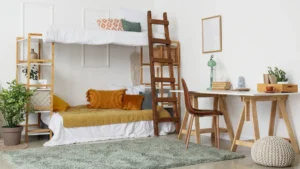
35. Bunk Beds with Storage Stairs
Bunk beds with built-in staircase steps (rather than a ladder) offer a safer climb and hidden storage inside each step — usually pull-out drawers for clothes, books, or toys. This design doubles sleeping capacity and adds the equivalent of a small dresser without any additional floor space. Ensure the bed meets CPSC guardrail guidelines and that the ceiling height allows at least 36 inches of clearance above the top mattress.
Pros: Two beds plus drawer storage in one footprint, safer stair access than ladders.
Cons: Large, heavy piece; difficult to move; stairs take slightly more floor space than a ladder.
Budget range: $400–$1,200.
36. Loft Beds with Play or Study Zone Underneath
A loft bed raises the sleeping surface and opens the floor below for a desk, a reading corner, or a play tent. For older kids and teens, a desk-and-shelf setup underneath creates a dedicated study area. For younger children (age six and up per CPSC guidelines), the space below can be a cushioned play zone. Ensure guardrails are on all open sides and the mattress base is solid.
Pros: Doubles usable floor space.
Cons: Top bunk not safe for children under six; limited ceiling clearance in some rooms.
Budget range: $200–$800.
37. Convertible Toddler‑to‑Teen Beds
A convertible bed starts as a crib, transitions to a toddler bed, then extends to a twin or even a full-size bed as the child grows. The upfront cost is higher, but you buy one bed instead of three over 15 years. This is also a space-saving strategy in that it prevents you from needing to store an outgrown bed while shopping for the next one.
Pros: Long-term value, grows with the child, reduces furniture turnover.
Cons: Higher initial investment; the aesthetic may feel dated after many years.
Budget range: $300–$900.
38. Storage Benches for Toys
A low storage bench along a wall serves as seating, a surface for stacking books, and a lidded toy chest. Choose a bench with a soft-close hinge on the lid to prevent small fingers from getting pinched. Models with open cubbies underneath (rather than a single large cavity) help kids learn to sort and organize their own belongings.
Pros: Seating plus toy storage, encourages tidiness.
Cons: Single-cavity benches become a dumping ground without internal dividers.
Budget range: $50–$250.
Renter-friendly: Yes.
39. Wall‑Mounted Fold‑Down Desks and Tables for Kids
The same fold-down desk concept from the home office section works beautifully in a kids’ room. Mount a small fold-down table at the right height for your child — roughly 22 to 25 inches for ages 5 to 8, 25 to 28 inches for ages 9 to 12 — and pair it with a stool that tucks underneath. When homework is done, the table folds flat, and the floor is free for play. Adjustable-height models can grow with the child.
Pros: Dedicated work surface that disappears, adjustable models grow with the child.
Cons: Requires wall mounting.
Budget range: $50–$200.
Owner / committed-renter solution.
40. Murphy Beds for Shared Kids Rooms
In a room shared by two children, twin-size horizontal Murphy beds (one stacked above the other, or side by side) fold up against the wall during the day, opening the entire floor for play. Some horizontal Murphy bed models include a fold-down desk surface on the front panel. This is a significant investment, but in a room under 100 square feet shared by two kids, it can transform the livability of the space.
Pros: Frees maximum floor space in shared rooms, clean daytime appearance.
Cons: Requires professional installation; high price point.
Budget range: $700–$2,500 per unit.
Bathroom & Entryway — 5 Space‑Saving Ideas
These two areas are often afterthoughts, but they set the first and last impression of your home and are notorious for clutter. Small changes here deliver outsized results.
41. Over‑Toilet Ladder Shelves or Cabinets
The wall space above the toilet is almost always empty. An over-toilet shelving unit, ladder shelf, or slim cabinet turns that gap into prime storage for towels, toiletries, baskets, and small plants. Freestanding ladder-style units do not require drilling and take advantage of vertical space without permanent modification. Look for a unit that fits snugly around your toilet tank width (usually 15 to 18 inches).
Pros: Uses dead vertical space, no installation on freestanding models.
Cons: Can feel crowded in very tiny bathrooms if over-styled.
Budget range: $25–$150.
Renter-friendly: Freestanding versions, yes.
42. Floating Vanities and Narrow Sinks
A wall-mounted floating vanity opens up floor space below, making the bathroom feel larger and easier to clean underneath. Narrow vanities — 18 to 20 inches deep instead of the standard 21 to 24 — reclaim inches in a small bathroom that can mean the difference between bumping into the opposite wall and having comfortable clearance. This is typically a renovation or owner upgrade.
Pros: Opens floor space, modern look, easier cleaning.
Cons: Requires plumbing compatibility and wall installation.
Budget range: $150–$800 for vanity and basin (not including installation).
Owner solution.
43. Entryway Benches with Hidden Shoe Storage
A bench at the front door with a flip-top lid or pull-out drawers gives you a place to sit while putting on shoes and hides footwear inside. For narrow entryways, a slim bench 12 to 14 inches deep keeps the walkway clear. Top it with a cushion and add hooks above for bags and keys, and you have a complete entry system in less than three square feet of floor space.
Pros: Seating, shoe storage, and entry organization in one piece.
Cons: Limited capacity in slim models; shoes need to be dry before storing inside a closed compartment.
Budget range: $60–$300.
Renter-friendly: Yes.
44. Mirror Cabinets with Storage Behind
A mirror that opens to reveal shelves behind it replaces two items — a mirror and a medicine cabinet — with one. In the bathroom, it holds medications, skincare, and dental supplies. In the entryway, it can store sunglasses, keys, and small accessories while giving you a last-look check before heading out. Surface-mount models sit on top of the wall and are easier to install than recessed versions.
Pros: Dual-purpose, visually clean when closed.
Cons: Surface-mount versions protrude slightly from the wall.
Budget range: $30–$200.
Renter-friendly: Surface-mount with adhesive or minimal hardware, yes.
45. Wall Hooks, Rails, and Pegboard Entry Systems
A row of wall hooks or a horizontal rail with movable hooks near the front door handles coats, bags, hats, leashes, and umbrellas. Pegboard entry systems let you rearrange hooks, small shelves, and holders as your needs change. In a small entryway, these wall-based systems keep everything off the floor and eliminate the need for a bulky coat rack or hall tree. Renter-friendly adhesive hooks rated for 5 to 10 pounds each work well for lighter items.
Pros: Keeps entryway floor clear, customizable, and easy to install.
Cons: Heavy coats and bags need stud-mounted hooks; adhesive hooks have weight limits.
Budget range: $10–$60.
Renter-friendly: Yes, with adhesive hooks.
5 Common Space‑Saving Furniture Mistakes to Avoid
Even with the best intentions, it is easy to undermine your own small-space strategy. These five mistakes come up again and again.
Buying furniture that is too large for the room. This is the most common and most expensive mistake. A sofa that technically fits wall-to-wall but leaves no walkway, a dining table that blocks the kitchen, or a bed frame that requires climbing over to reach the closet — all of these kill the livability of a small space. Go back to Principle 5 (Furniture Sizing and Measuring) and measure before every purchase, no exceptions.
Ignoring vertical wall space. If every storage and display piece in your apartment sits on the floor, you are using only one dimension of the room. Floating shelves, wall-mounted nightstands, over-door organizers, and tall, narrow bookcases (covered throughout the Living Room, Bedroom, and Kitchen sections above) leverage the vertical plane and keep the floor open.
Choosing heavy, dark furniture in an already small room. A large, dark wood dresser or a deep-toned upholstered armchair can make a small room feel like a cave. Refer back to Principle 3 (Visual Weight and Transparency): lighter colors, slim legs, and open bases help small rooms breathe. This does not mean everything has to be white — a single dark accent piece can look stunning — but the majority of your furniture should lean toward visual lightness.
Owning multi-functional furniture, you never actually convert. A sofa bed you never unfold, a lift-top table you never lift, or a fold-down desk you never fold down is just regular furniture that probably compromised on comfort or aesthetics for a feature you are not using. Be honest with yourself about whether you will actually use the convertible feature. If the answer is “maybe once a year,” you might be better off with a single-purpose piece that excels at its one job.
Filling the room with too many “smart” pieces. There is a tipping point where every item is trying to be clever — folding, stacking, rolling, transforming — and the room starts to feel like a puzzle rather than a home. Choose two or three high-impact multi-functional pieces (a storage bed, a drop-leaf table, a fold-down desk) and let the rest be simple, good-looking, and correctly sized. Principle 4 (Negative Space) is your guide here.
Space‑Saving Furniture Budget Guide
Not all space-saving upgrades require a large investment. Here is how to approach furnishing a small apartment across three budget tiers and decide which of your space-saving furniture ideas to prioritize first.
Under $150 — Quick Wins
This tier covers the small moves that make an immediate difference: over-door hooks and hanging shoe organizers, under-bed rolling drawer bins, a bedside caddy, a pegboard for the kitchen or entryway, a set of folding chairs for guest seating, basic storage ottomans, and adhesive wall hooks. These items require zero installation, are almost universally renter-friendly, and can be implemented in an afternoon. If your budget is extremely tight, start here — the cumulative impact of five or six $20 to $40 space-saving furniture ideas is surprisingly powerful.
$150–$600 — Key Upgrades
This range is where you replace a piece of furniture that is not working with one that works twice as hard. A good sofa bed, a compact modular sofa, a storage bed frame with drawers, a drop-leaf dining table, a fold-down desk, a rolling kitchen island, or an over-toilet shelving unit all fall into this band. Prioritize the room where you feel the most friction — if you bump into your coffee table every day, that is your first upgrade. If you cannot find a surface for your laptop, the fold-down desk is a better starting investment than redecorating the bedroom.
$600+ — Long‑Term Investments
Murphy beds, transforming coffee-to-dining tables, high-quality modular closet systems, and professional closet conversions live in this tier. These are worth the money if you plan to stay in your apartment for at least two to three years (or can take the piece with you). A Murphy bed at $1,500 that gives you 40 square feet of living space every day pays for itself in quality of life far faster than most other home purchases.
Where to Shop for Space‑Saving Furniture
You do not need to limit yourself to one retailer. For budget-friendly basics and modular storage systems, IKEA, Target, and Amazon cover the widest range at the lowest price points. For mid-range pieces with more style, Wayfair, Article, and CB2 offer small-space-specific collections that prioritize slim profiles and multi-functional designs. West Elm’s small-space line balances aesthetics and function at a premium-but-not-luxury price. For high-end transforming furniture — wall beds, convertible tables, and modular systems — specialist retailers like Resource Furniture and Expand Furniture carry European-designed mechanisms that are engineered to last decades. Always check dimensions, read reviews specifically from people in small apartments, and confirm the return policy before buying online.
FAQ — Space‑Saving Furniture Ideas
What is the best furniture for a studio apartment?
The best furniture for studio apartments serves multiple functions and maintains clear zones without permanent walls. A storage bed frame (or Murphy bed if your budget allows), a drop-leaf dining table that doubles as a desk, a slim console table to divide the sleeping area from the living area, and a storage ottoman for flexible seating and hidden blanket storage form a strong foundation. Prioritize pieces that convert, fold, or store inside themselves so every square foot pulls double duty.
What furniture makes a small room look bigger?
Furniture with slim or tapered legs that reveal the floor underneath makes a room feel more spacious because the eye reads a continuous floor line. Transparent or acrylic pieces — a glass coffee table, clear dining chairs — occupy space without blocking sightlines. Light-colored and low-profile furniture (sofas with a low back, platform beds without a footboard) keeps visual weight down. Finally, wall-mounted floating furniture like shelves and nightstands opens the floor below, which creates the perception of more square footage than …which creates the perception of more square footage than there actually is. Mirrors amplify all of these effects: a large wall mirror opposite a window bounces light deeper into the room and visually doubles the space.
Is a Murphy bed really worth it in a small space?
It depends on how you use your home and how long you plan to stay. In a studio or micro-apartment where the bed dominates the floor plan, and you spend waking hours stepping around it, a Murphy bed can be transformative — you literally get the equivalent of another room’s worth of usable space during the day. If you are an owner or a long-term renter (two to three years or more), the investment often makes sense. If you move frequently or are on a tight budget, a high-quality storage bed or sofa bed will usually give you enough flexibility at a fraction of the price and without wall modifications.
How do I furnish a room that is under 200 square feet?
Start by defining zones: sleep, sitting/working, and storage. Choose one primary multi-functional piece for each zone: a storage or loft bed for sleeping and clothing, a drop-leaf table or fold-down desk for eating and working, and a slim wardrobe or modular shelving unit for everything else. Keep the furniture footprint tight: avoid anything deeper than 18–20 inches except the bed. Use vertical storage aggressively (walls, backs of doors, above-door shelves) and stick to a restrained color palette so the room feels cohesive rather than chopped up. Finally, be ruthless about what comes into the room — every new piece needs a clear job.
What is the best sofa for a small living room?
Look for a compact two-seater or loveseat with slim arms and legs, a total width under about 80 inches, and a seat depth of 32–36 inches. If you host overnight guests, a click-clack sofa bed or a compact pull-out in that size range is ideal. Avoid bulky rolled arms, skirted bases that hide the legs (they add visual weight), and oversized recliners that need lots of clearance behind them. In very small rooms, a chaise sofa or sectional with a single chaise on one side can be more space-efficient than a standard sofa plus a separate armchair.
What space‑saving furniture is renter‑friendly (no drilling required)?
Plenty. Freestanding bookcases and ladder shelves, storage ottomans and benches, under-bed rolling drawers, over-door hooks and organizers, pegboards mounted with removable adhesive strips, folding and stackable chairs, drop-leaf tables on casters, rolling kitchen islands, and slim sideboards are all excellent renter-friendly options. Even many “floating” looks can be faked with tension-rod systems or heavy-duty adhesive hardware. Reserve wall drilling for pieces that truly need it, like Murphy beds or heavy fold-down desks, and only if your lease allows.
How much should I budget for furnishing a small apartment with space‑saving pieces?
For a basic but functional setup in a studio or one-bedroom, expect to spend around $1,500–$3,000 if you mix budget-friendly retailers with a few mid-range pieces. That typically covers a sofa bed or compact sofa, a storage bed frame, a small dining table that can double as a desk, a rolling kitchen cart or island, and essential storage like shelves and wardrobes. If your budget is very tight and you are willing to thrift and DIY, you can assemble a starter kit of space-saving furniture for under $800 by prioritizing a good bed, one multi-use table, and clever organizers. At the high end, if you add Murphy beds and high-end transforming tables, the total can easily reach $5,000+, but those investments are usually only worth it for owners or long-term renters.
Conclusion
Living in a small home does not mean you have to settle for cramped, cluttered, or temporary-feeling rooms. It simply asks you to be more intentional. When every piece of furniture earns its place — by doing more than one job, fitting your space correctly, and supporting the way you actually live — even a 400-square-foot apartment can feel calm, comfortable, and genuinely you. The right space-saving furniture ideas turn the square footage you already have into a room that actually works.
You do not have to overhaul every room at once. Start with the single area that frustrates you the most: maybe the living room that never quite works for guests, the bedroom with nowhere to store clothes, or the kitchen where counter space disappears the moment you start cooking. Choose one high-impact space-saving piece for that room — a storage bed, a drop-leaf dining table, a fold-down desk, a rolling island — and let yourself live with the change for a few weeks before adding more.
As you upgrade room by room, the goal is not to cram in as many clever gadgets as possible, but to create a home that feels open, supportive, and easy to live in. When the furniture is doing its job, you get to stop fighting your square footage and start enjoying it. For more inspiration, explore our guides to Small Apartment Decor Ideas for Women and Small Bedroom Ideas for Women, where you will find color palettes, lighting strategies, and layout ideas that complement the furniture picks in this article.