
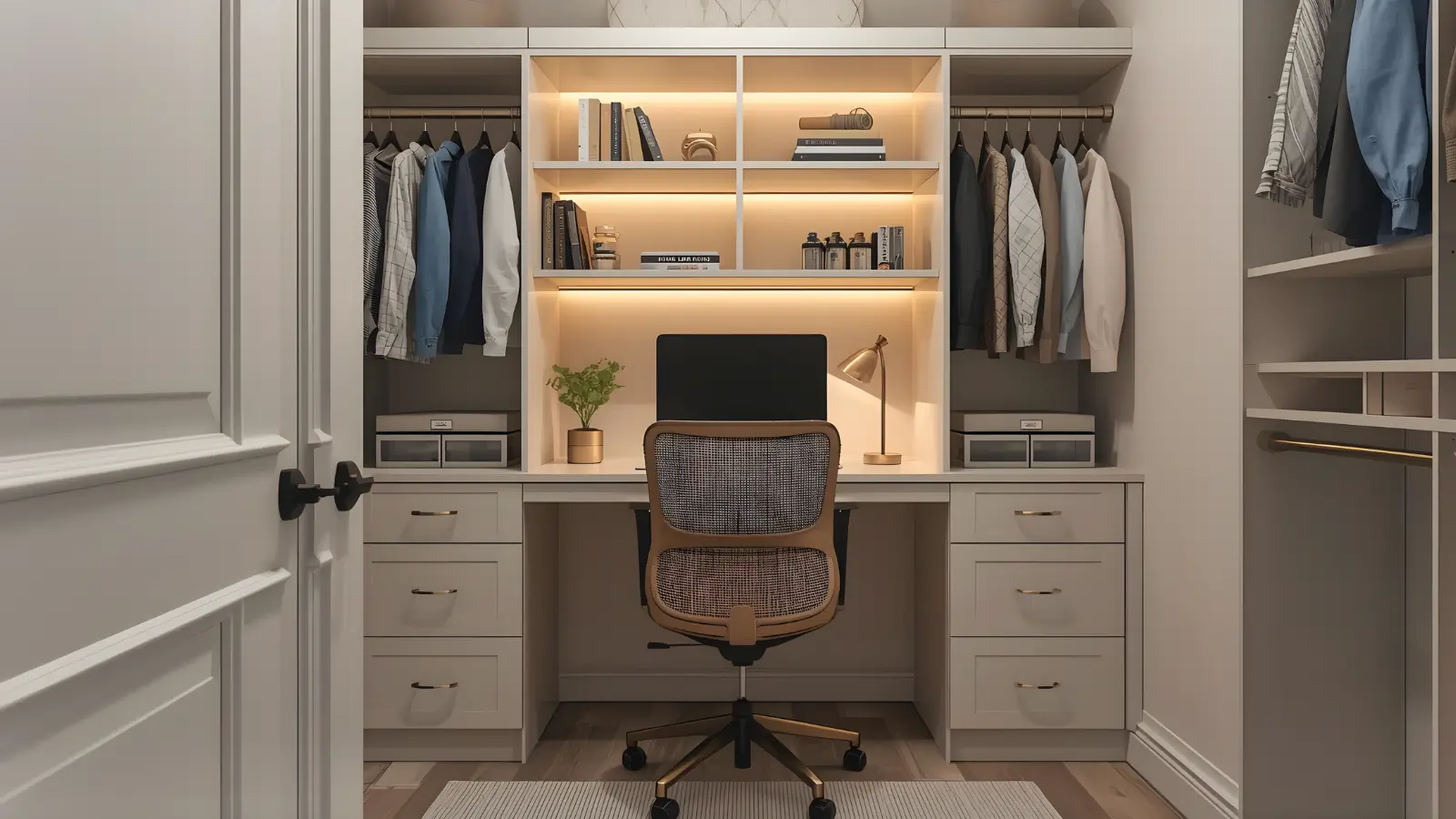

Working from home in a small apartment often means getting creative with every square foot. If you have a closet you can spare—even a shallow reach-in—a “cloffice” might be the most efficient home-office solution you’ve never considered. These cloffice ideas walk you through every stage of building a closet office that genuinely works: choosing the right closet, setting up an ergonomic workspace, staying within budget, and keeping it all renter-friendly when you need to.
Whether you’re hunting for a tiny closet desk idea for a studio apartment or planning a full walk-in closet home office conversion, this guide covers dimensions, product recommendations, IKEA hacks, and the mistakes that derail most DIY cloffice projects before the chair even rolls in.
What Is a Cloffice?
A cloffice-closet + office-is a dedicated workspace carved out of a closet. The concept gained momentum during the remote-work surge that began in 2020, and it has stayed relevant because the underlying problem never went away: millions of people work from home in apartments and small houses that don’t have a spare room.
The appeal is straightforward. A cloffice gives you a defined work area you can close off at the end of the day, protecting both your living space and your mental boundaries between work and rest. Even a 24-inch-deep reach-in closet can hold a functional desk, task lighting, and enough storage for a full workday—provided you plan the layout before you start buying furniture.
A closet office also tends to be more budget-friendly than converting an entire room. You’re working with a small footprint, so materials, lighting, and décor costs stay low. And because the space is enclosed on three sides, you get a natural sense of focus and visual separation from the rest of your home office without building a single wall.
Types of Closets You Can Convert Into a Cloffice
Not every closet works the same way as a workspace. The table below compares the most common closet types and what each one supports.
| Closet Type | Typical Dimensions | Recommended Desk Style | Difficulty | Budget Range |
|---|---|---|---|---|
| Standard reach-in | 24″ deep × 48–72″ wide × 80″ tall | Wall-mounted floating shelf desk or cut-to-fit butcher block | Easy | $50–$300 |
| Double reach-in | 24″ deep × 72–96″ wide × 80″ tall | Full-width countertop on brackets or ALEX drawer units | Easy–Moderate | $100–$600 |
| Small walk-in | 48–60″ deep × 48–72″ wide × 96″ tall | Freestanding desk (up to 48″ wide) with side shelving | Moderate | $200–$1,000 |
| Large walk-in | 60″+ deep × 72″+ wide × 96″ tall | L-shaped desk or desk plus lateral filing cabinet | Moderate–Hard | $300–$2,000+ |
| Wardrobe / armoire | 24″ deep × 36–48″ wide × 72–78″ tall | Fold-down or pull-out tray desk | Easy | $50–$400 |
| Under-stair closet | Varies (sloped ceiling) | Custom-cut triangular desk to match angle | Hard | $150–$800 |
If your closet is a standard reach-in—about 24 inches deep and 4 to 6 feet wide—you already have enough room for a comfortable small closet office. Walk-in closets give you the bonus of floor space for a chair to roll freely. Under-stair closets require more customization but make dramatic use of otherwise dead space.
For more layout inspiration tailored to tight footprints, see our small-space design guide.
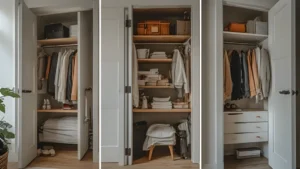
How to Build a Cloffice: Step-by-Step
Building a DIY cloffice doesn’t require advanced carpentry skills. Follow these steps in order to avoid the most common rework.
Step 1 — Measure everything. Record the width, depth, height, and the position of any electrical outlets, light switches, or HVAC vents inside the closet. Write down the door-opening clearance as well. You’ll reference these numbers at every decision point.
Step 2 — Remove the closet rod and existing shelving. In most reach-in closets, the rod and single shelf are held by a few screws or bracket clips. Fill the screw holes with spackle and sand smooth. If you’re renting, save the hardware in a labeled bag for reinstallation at move-out.
Step 3 — Plan your desk height. Standard desk height is 28 to 30 inches from the floor. If you’re using a wall-mounted shelf as your desk surface, measure from the floor while seated in the chair you plan to use, and mark the wall at elbow height. This is far more accurate than guessing.
Step 4 — Install the desk surface. For reach-in closets, a butcher-block shelf or laminate countertop supported by L-brackets (rated for the weight) is the simplest approach. For walk-ins, a freestanding desk often works better because it lets you reposition later. A cut-to-fit IKEA LAGKAPTEN tabletop (47¼″ or 55⅛″ wide) on ALEX drawer units is one of the most popular combinations.
Step 5 — Add lighting. Closets rarely have overhead fixtures suitable for desk work. Install an LED desk lamp or mount an LED light bar under the shelf above your desk. Aim for at least 300 lux at the desk surface, which is the lower end of the recommended range for office tasks according to the Illuminating Engineering Society (IES).
Step 6 — Route power and cable management. Run a slim power strip along the back wall. Use adhesive cable clips to keep cords organized and off your desk surface. If the closet doesn’t have an outlet, route an extension cord from the nearest wall outlet and conceal it with a paintable cord cover along the baseboard.
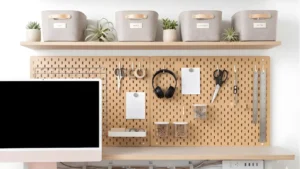
Step 7 — Add storage above and around the desk. Floating shelves, a small pegboard, or a wall-mounted file organizer can handle supplies without eating into your desk space. Install shelves at least 18 to 22 inches above the desk surface so you have room for a monitor or laptop screen.
Step 8 — Set up your chair and test the fit. Roll your chair into the closet space and sit at the desk. Check that you can push back from the desk comfortably without the chair hitting the closet door frame. If clearance is tight, a backless stool or an armless task chair is a practical alternative.
Cloffice Ideas by Style
The style of your cloffice should match the room it opens into so the space feels intentional when the doors are open.
Minimalist. White or light-wood desk surface, no visible clutter, one or two floating shelves, a single plant, and a concealed cable run. Use matching white bins on upper shelves. This style works well in modern apartments where visual noise is already high.
Boho / Eclectic. Removable peel-and-stick wallpaper on the back wall, a rattan or cane desk organizer, woven baskets on shelves, and a mix of warm textures. A macramé shelf or hanging planter adds dimension without taking up desk space.
Scandinavian. Light birch or oak desk surface, matte black brackets, one pegboard panel in white or natural wood, and a simple clip-on lamp. The emphasis here is on function with restrained warmth.
Glam. Faux-marble contact paper on the desk surface, gold or brass brackets, a velvet desk chair in blush or emerald, and acrylic organizers. An LED strip behind the upper shelf edge creates a soft glow effect.
Mid-Century Modern. A walnut-toned butcher-block desk surface, tapered legs if space allows a freestanding desk, brass or matte-black task lamp, and a single statement art print on the back wall.
Regardless of style, the back wall of the closet is your biggest design opportunity. Because the area is small—usually under 15 square feet—even a single accent treatment like wallpaper, a painted accent color, or a mounted corkboard makes a noticeable impact.
Cloffice Ideas by Budget
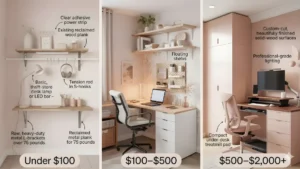
Under $100
At this tier, you’re working with what you have and spending only on essentials. Use an existing shelf or a reclaimed wood plank supported by two heavy-duty L-brackets (around $5–$12 for a pair rated at 75+ pounds). Add a thrift-store desk lamp or a USB-powered LED bar ($10–$20), and use a tension rod with S-hooks above the desk for hanging small baskets or headphones. An adhesive power strip ($12–$18) keeps your electronics charged. Total investment stays under $80, leaving room for a few organizational accessories.
For planning your total spend, our room makeover budget planner can help you track every line item.
$100–$500
This is the sweet spot for most cloffice builds. You have enough budget for a proper desk surface (IKEA LAGKAPTEN tabletop at roughly $30–$50, or a pre-cut butcher block from a home-improvement store for $50–$90), one ALEX drawer unit ($95), floating shelves ($15–$40 each), a quality LED desk lamp ($30–$60), and a basic ergonomic task chair ($80–$180). You can also add peel-and-stick wallpaper ($25–$40 per roll) and a small pegboard ($15–$30). This budget level allows you to build a cloffice that looks and functions like a purpose-built home office.
$500–$2,000+
At the upper end, you can invest in custom-cut solid-wood surfaces, a PAX-frame wardrobe system configured as a closet office shell, professional-grade lighting, a high-quality ergonomic chair, and a monitor arm. Consider adding a compact under-desk treadmill pad or a standing-desk converter if you have the depth. You might also hire a carpenter to build a custom desktop that fits the exact width and depth of your closet, eliminating gaps and maximizing every inch.
Best IKEA Hacks for a Cloffice
IKEA products appear in nearly every popular closet desk build for good reason: they’re modular, affordable, and available in neutral finishes that blend into most closets. Here are the most effective hacks for a cloffice.
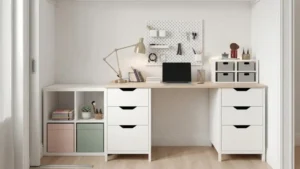
ALEX drawer unit as desk base. The ALEX drawer unit (14⅛″ wide × 22⅞″ deep × 27½″ tall) is almost exactly standard desk height. Place one unit on each side of your closet or one unit on one side with a single ADILS leg on the other, then set a LAGKAPTEN or LINNMON tabletop across them. For a reach-in closet that’s 48 to 55 inches wide, the 47¼″ LAGKAPTEN top fits nearly flush. The total cost for this setup is typically between $160 and $230.
KALLAX as a desk-and-storage combo. A horizontal 2×2 KALLAX unit (30⅜″ wide × 15⅜″ deep × 30⅜″ tall) doubles as both a desk pedestal and open storage. Pair it with a tabletop that extends past the KALLAX on one side for legroom. KALLAX inserts—drawers, doors, or fabric bins—keep supplies hidden and organized. The 2×4 KALLAX turned on its side can also serve as a full back wall of cubbies behind or beside your desk if you have a walk-in closet.
BILLY bookcase flanking a desk. If your closet is wide enough (72 inches or more), place a narrow BILLY bookcase (15¾″ wide × 11″ deep × 79½″ tall) on one or both sides of your desk. This creates a built-in library look and gives you floor-to-ceiling storage in a footprint that’s under 16 inches wide per unit. Secure the BILLY units to the wall with the included anti-tip hardware.
PAX frame as a cloffice shell. The IKEA PAX wardrobe system is designed for closets, which makes it a natural fit in the other direction: use a PAX frame (39⅜″ wide × 22⅞″ deep × 79¼″ tall) as the structure of a freestanding cloffice. Remove the doors, install a shelf at desk height, add KOMPLEMENT drawers or pull-out trays for storage above and below, and mount a light inside the top of the frame. This approach is especially useful if you’re converting an open wall nook rather than an actual closet.
SKÅDIS pegboard for wall organization. The SKÅDIS pegboard (22″ × 22″) mounts directly on the closet’s back wall and holds containers, hooks, and elastic bands for supplies. It’s one of the fastest ways to add organized vertical storage without drilling multiple holes—just two mounting points hold the entire board.
Browse more furniture options for compact workspaces in our desks guide and storage solutions roundup.
Renter-Friendly Cloffice Solutions
If you can’t drill into walls or make permanent changes, you can still build a fully functional closet home office. Every product and technique below can be removed without leaving damage.
Freestanding desk setups. Instead of wall-mounted brackets, use a narrow freestanding desk or a tabletop resting on two ALEX drawer units. Nothing attaches to the wall, and the entire setup disassembles in minutes for move-out.
Command Strips and adhesive hooks. 3M Command Strips (damage-free, rated up to 16 pounds per pair for the large strips) can hold lightweight floating shelves, small pegboards, and framed art. For a cloffice, two or three pairs of large strips can support a slim shelf for décor or small supplies—just avoid loading it with heavy books or monitors.
Tension rods. A spring-loaded tension rod installed between the closet’s side walls functions as a hanging rail for baskets, organizers, or a fabric shade to hide the workspace when you’re off the clock. No screws, no holes.
Removable wallpaper. Peel-and-stick wallpaper on the closet’s back wall instantly elevates the look of a cloffice. Modern formulations peel off cleanly from smooth, painted drywall. Test a small swatch in an inconspicuous spot first, especially if the closet walls have textured paint.
Freestanding shelving. A narrow three-tier or four-tier shelf unit placed beside or behind your desk adds vertical storage without wall mounting. Look for units that are 12 to 16 inches deep—deep enough for binders and bins but shallow enough to fit inside a closet without blocking legroom.
Clip-on and clamp lights. A clamp-on LED desk lamp attaches directly to the desk surface or a shelf edge, eliminating the need for a ceiling fixture. Battery-powered LED puck lights with adhesive backs can also be placed under upper shelves for ambient lighting.
The key principle for renters: choose furniture that stands on its own and accessories that adhere temporarily. Build the cloffice so you can reverse every change in under an hour.
Cloffice Organization and Storage Ideas
Small spaces demand deliberate organization. A cloffice with poor storage quickly becomes a cluttered shelf you avoid rather than a workspace you use.
Use the vertical space. In a standard 80-inch-tall closet, the desk surface sits at about 29 inches. That leaves roughly 50 inches of wall space above the desk. Install two to three floating shelves spaced 12 to 14 inches apart, or mount a single tall pegboard that spans most of that height.
Assign zones. Dedicate the area directly above the monitor for reference materials or décor only—nothing you need to grab frequently. Place everyday supplies (pens, notebooks, chargers) within arm’s reach on a shelf or in a desk drawer. File storage goes on the lowest shelf or inside a drawer unit.
Containerize everything. Open shelves look tidy only when the items on them are contained. Use matching bins, trays, or baskets to group supplies. Label the bins if they’re opaque. Acrylic or clear containers work well if you prefer to see what’s inside at a glance.
Pegboard and wall grids. A 22″ × 22″ IKEA SKÅDIS pegboard or a metal wall grid can hold scissors, tape, headphones, and notes without opening a single drawer. This keeps the desk surface clear for actual work.
Door-back storage. If your closet still has a door, the back of that door is free real estate. An over-the-door organizer with clear pockets holds mail, charging cables, sticky notes, and small supplies. For bifold closet doors, a magnetic strip or adhesive hooks on the inside face serve the same purpose.
Cable management. Route all cables behind the desk surface using adhesive cable clips or a small cable tray mounted underneath the desktop. A single power strip with USB ports, secured to the underside of the desk with velcro strips, keeps cords invisible.
Ergonomics, Ventilation, and Health Tips
A cloffice is a real workspace, and it deserves real ergonomic attention. Working in a poorly configured closet for eight hours a day can lead to neck strain, eye fatigue, and back discomfort just as easily as a bad open-floor desk setup.
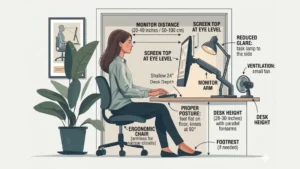
Monitor position. According to OSHA’s Computer Workstations eTool monitor guidelines, your monitor should be placed directly in front of you, at least 20 inches from your eyes, with the top line of the screen at or slightly below eye level. In a cloffice, where desk depth may be limited to 24 inches, a monitor arm that pushes the screen back toward the wall—or a compact 22- to 24-inch monitor—helps you maintain the recommended 20- to 40-inch viewing distance. Laptop users should strongly consider an external keyboard so the screen can be elevated to the correct height. Check how your current setup measures up with our ergonomics score tool.
Chair selection. A full-size ergonomic chair may not fit inside a narrow closet. In that case, an armless task chair with lumbar support and adjustable height is the best compromise. The seat height should allow your feet to rest flat on the floor with your knees at roughly 90 degrees. If the closet’s depth prevents you from rolling a chair in fully, consider a stool with a footrest ring—this keeps your posture neutral while requiring less depth.
Desk height and wrist position. As noted in OSHA’s desk setup guidance, the desk surface should sit at a height where your forearms are parallel to the floor and your wrists are straight when typing. For most people, this is 28 to 30 inches. If your cloffice desk surface is slightly too high, raise your chair and add a footrest; if it’s too low, place furniture risers under the legs or use a thicker desktop.
Lighting. Eye strain in closets often comes from inadequate lighting, not screen brightness. A combination of task lighting (directed at your desk surface) and ambient lighting (a shelf-mounted LED strip or puck lights) reduces harsh shadows and contrast. Position your task lamp so it doesn’t create glare on the monitor screen—typically off to the side, opposite your dominant hand.
Ventilation and airflow. Closets are enclosed spaces that don’t usually connect to your home’s HVAC system. When you add a laptop, a monitor, and your own body heat, temperatures can climb noticeably. Address this by keeping the closet doors open while you work, running a small USB desk fan pointed toward the opening, and—if possible—placing a compact air purifier on a shelf. Even a basic 6-inch fan creating cross-ventilation between the closet and the adjacent room makes a measurable difference. If you’re in a humid climate, a mini dehumidifier (under $40) prevents moisture buildup that can damage electronics and paperwork.
Breaks. The 20-20-20 rule—every 20 minutes, look at something 20 feet away for 20 seconds—is especially important in a closet, where your sight lines are short. Set a timer. Stand up and step out of the closet at least once per hour to stretch and reset.
Common Cloffice Mistakes to Avoid
Even well-intentioned cloffice builds go wrong when a few critical details are overlooked. Here are the mistakes that cause the most frustration.
Skipping the measurement step. This is the single most common mistake. People buy a desk or tabletop, bring it home, and discover it’s two inches too wide or too deep for the closet opening. Measure the interior width, depth, height, and the door-frame clearance before purchasing anything.
Ignoring electrical access. A closet without an outlet—or one with an outlet blocked by the desk—creates a tangle of extension cords running across the floor. Plan your power routing in Step 6, not as an afterthought.
Mounting a desk surface too high or too low. Eyeballing desk height instead of measuring leads to ergonomic problems that compound over weeks of use. Sit in your chair, measure from the floor to your elbow, and set your desk surface at that height.
Neglecting ventilation. A closed closet with a running laptop can reach uncomfortably warm temperatures within an hour. Always keep air moving, whether through an open door, a fan, or both.
Overloading the space. A cloffice should hold what you need for work—not overflow supplies, seasonal decorations, or items that belong elsewhere. If the closet is also storing winter coats and boxes, either relocate those items first or the cloffice will feel cramped and chaotic from day one.
Forgetting about the chair footprint. Your desk may fit perfectly, but if you can’t push your chair back far enough to stand up, the setup doesn’t work. Allow at least 24 to 30 inches of clearance between the desk edge and any wall or door behind you.
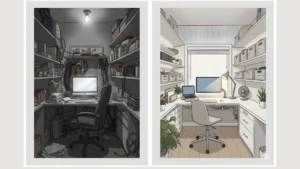
Using harsh overhead lighting as the only light source. A single bare bulb on the closet ceiling casts hard shadows on the desk and creates glare on screens. Layer your lighting: task lamp for the desk, LED strip for ambient, and the overhead fixture turned off or dimmed.
FAQ
How deep does a closet need to be for a cloffice?
A closet as shallow as 22 to 24 inches can work as a cloffice if you use a wall-mounted floating desk and position your chair outside the closet opening. For a setup where the chair fits inside the closet, you need at least 44 to 48 inches of depth—enough for the desk surface plus room to sit comfortably.
Can I build a cloffice in a rental apartment without losing my security deposit?
Yes. Use freestanding furniture such as IKEA ALEX drawer units with a loose tabletop, Command Strips for lightweight shelves, peel-and-stick wallpaper, and clip-on lighting. Avoid drilling into walls. Save any hardware you remove (like closet rods or shelf brackets) so you can reinstall them at move-out.
How much does it cost to set up a cloffice?
A basic cloffice can be built for under $100 using a repurposed shelf, brackets, and a desk lamp. A mid-range setup with an IKEA desk, drawer unit, shelves, and lighting typically costs $150 to $500. Premium builds with custom surfaces, ergonomic chairs, and professional lighting can reach $1,000 to $2,000 or more.
What is the best desk for a reach-in closet?
A wall-mounted floating shelf desk or a cut-to-fit laminate or butcher-block countertop on L-brackets is the most space-efficient option for a standard 24-inch-deep reach-in closet. The desk surface should span the full width of the closet interior for maximum workspace.
How do I keep a closet office cool?
Keep the closet doors open while you work. Place a small USB fan on the desk or a shelf to push warm air out of the enclosure. If the closet has no HVAC vent, a portable air circulator near the closet opening creates cross-ventilation. In humid environments, add a compact dehumidifier to prevent moisture buildup.
Do I need to remove the closet doors to make a cloffice?
You don’t have to, but it helps. Removing the doors gives you more visual space, better airflow, and easier chair access. If you prefer to hide the cloffice when it’s not in use, keep the doors—bifold and sliding doors work well because they don’t swing into the room. Curtains hung from a tension rod are a renter-friendly alternative to solid doors.
What lighting works best in a closet office?
A combination of a focused LED desk lamp for task lighting and an LED light strip under an upper shelf for ambient light works best. Avoid relying solely on the closet’s overhead fixture, which typically casts harsh, direct shadows. Aim for at least 300 lux at the desk surface for comfortable reading and screen work.
Can I use a standing desk in a cloffice?
If your closet is deep enough to stand comfortably inside (at least 28 to 30 inches of depth) and tall enough to accommodate the standing desk at its full height, a compact standing-desk converter placed on the existing desk surface is a practical option. In shallower closets, a wall-mounted fold-down desk set at standing height works if you stand outside the closet opening.
Final Recommendations
A well-planned cloffice is one of the smartest ways to carve out a dedicated workspace in a small apartment or home. The core formula is simple: choose the right closet, measure carefully, set your desk at the correct height, layer your lighting, and keep the space organized and ventilated.
Start with the closet-type comparison table earlier in this guide to identify what your space can realistically support. If you’re on a tight budget, the under-$100 approach—brackets, a reclaimed shelf, and a good lamp—gets you working in a weekend. If you have more room to invest, the IKEA ALEX-plus-LAGKAPTEN combo or a PAX-frame build delivers a setup that looks and performs like a permanent built-in.
Above all, treat ergonomics as non-negotiable. A cloffice that causes back pain or eye strain after a month of use isn’t a space saver—it’s a problem. Set your monitor at the right distance and height, choose a chair that supports your posture, and take regular breaks away from the enclosure.
These cloffice ideas are designed to work in the real world—where leases have rules, budgets have limits, and closets come in imperfect shapes. Pick the ideas that fit your situation, build in stages if you need to, and enjoy a workspace that disappears behind a door at the end of the workday.
For more ideas on furnishing and optimizing compact work areas, explore our full home office furniture collection.