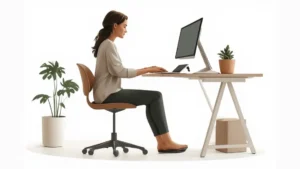


If you’re between 4’11” and 5’4″, you already know the frustration. You sit down in what reviewers call the “best office chair of the year,” and your feet dangle. The lumbar pad presses into your shoulder blades. The seat pan pushes into the backs of your knees. You’re left shifting, stacking pillows, and ending the workday with a sore lower back that no amount of stretching seems to fix.
The problem isn’t you — it’s the chair. The vast majority of office seating is engineered around a default body that stands roughly 5’8″ to 5’11” and weighs 170–200 pounds. That default body is not yours, and no amount of “universal adjustability” marketing changes the underlying geometry. An ergonomic chair petite women can actually sit in requires specific dimensions: a lower minimum seat height, a shallower seat depth, narrower lumbar support positioned lower on the backrest, and armrests that don’t force your shoulders upward.
This guide is built to solve that problem completely. We’ll walk you through exactly how to measure your body for a chair, what specifications to look for at every height between 4’11” and 5’4″, which features genuinely matter (and which are marketing noise), and which chairs deliver the best fit at three distinct price points. Every recommendation is grounded in published ergonomic standards and real-world dimension checks — no vague “comfortable for most people” language, no filler.
Let’s find you a chair that fits like it was made for you — because with the right specs, it will be.
Quick Picks at a Glance
Before we get into the details, here are three standout options across budget tiers — each verified for petite-friendly dimensions. We’ll break down the full reasoning later, but if you’re short on time, start here.
Budget Pick (Under $300): HON Ignition 2.0 (Small Seat) Minimum seat height of 15.5″, seat depth adjustment standard, and a compact frame that works well for women around 5’0″–5’4″. It’s not glamorous, but the fit is genuinely good, and the build quality holds up over years of daily use.
Mid-Range Pick ($300–$600): Steelcase Leap (Petite Configuration) Steelcase offers a petite cylinder option that brings the minimum seat height down to approximately 14.5″. Combined with the Leap’s excellent seat depth slider and flexible backrest, this is one of the most accommodating chairs for shorter frames on the market. If your home office setup is your full-time workspace, this is where the investment starts to pay for itself.
Premium Pick ($600+): Herman Miller Aeron (Size A) The Size A Aeron was specifically designed for smaller bodies, with a minimum seat height of 15″, a narrower seat width, and proportionally scaled lumbar support. It’s a long-term investment that holds resale value remarkably well and delivers elite build quality.
Each of these chairs solves the core problem differently, and the “best” choice depends on your height, your budget, and how many hours a day you’re seated. We’ll unpack all of that below.
Why Most Chairs Don’t Fit Petite Women
Understanding why standard chairs fail shorter bodies isn’t just academic — it helps you evaluate any chair you encounter, not only the ones in this guide.
The seat height problem is the most immediate. The American National Standards Institute (ANSI) and the Business and Institutional Furniture Manufacturers Association (BIFMA) set the standard adjustable range for office chair seats at roughly 16″ to 20.5″ from the floor. For a woman who stands 5’2″, the ideal seat height — the point where feet rest flat, and thighs are parallel to the floor — is approximately 15.0″ to 15.5″. For a woman at 4’11”, that number drops closer to 14″. Most chairs simply cannot go low enough. The result is constant pressure on the underside of the thighs, restricted circulation, and a pelvis that tilts backward, flattening the natural lumbar curve.
Seat depth compounds the issue. A standard office chair seat pan runs 17″–19″ deep. For a petite frame with a shorter upper leg (femur), that depth means the front edge of the seat presses into the area just behind the knees. This creates a choice between two bad options: scoot forward and lose all backrest contact, or sit back and accept the knee pressure. A proper petite ergonomic chair needs either a shorter fixed seat depth (under 17″) or a seat depth slider that allows you to bring the effective depth down to 15″–16.5″.
Lumbar support placement is the subtle failure. On a standard chair, lumbar support sits 6″–10″ above the seat. For a shorter torso, the natural lumbar curve (the inward arch of the lower spine) may sit only 4″–7″ above the seat. When the support pad is too high, it pushes against the mid-back or even the lower thoracic spine, which actively works against healthy posture rather than supporting it.
Armrest height matters more than people realize. If armrests can’t drop low enough, they push your shoulders into a shrugged position throughout the day. This creates tension in the trapezius muscles and can contribute to neck pain and headaches. For a petite user, armrests need to reach a minimum low point that allows elbows to rest at roughly 90 degrees while shoulders remain relaxed.
In short, a standard chair doesn’t just feel uncomfortable for a petite woman — it actively promotes poor posture. The ergonomic principles that apply to every body type become impossible to achieve when the chair’s geometry doesn’t match the user’s proportions.
How to Measure Your Body Before Buying
You wouldn’t buy jeans without knowing your inseam. Treat your chair the same way. Four measurements determine your ideal chair specs, and each takes less than a minute.
Measurement 1: Popliteal Height (Ideal Seat Height) Sit on a firm, flat surface with your feet flat on the floor and your knees bent at 90 degrees. Measure from the floor to the crease behind your knee. This measurement, minus about half an inch (to account for slight seat cushion compression), is your target seat height. For most women between 4’11” and 5’4″, this falls between 14″ and 16″.
Measurement 2: Upper Leg Length (Ideal Seat Depth) While seated in the same position, measure from the back of your buttocks to the crease behind your knee. Subtract 2″–3″ from this number. That’s your ideal seat depth — you want a gap of at least two finger-widths between the seat edge and the back of your knees. Typical range for petite women: 15″–17″.
Measurement 3: Lumbar Height (Ideal Lumbar Support Position). Stand with your back against a wall. Place your hand in the natural inward curve of your lower back. Measure from the seat of your chair (or the surface you’ll sit on) to the center of that curve. This tells you where lumbar support needs to land. Typical range for petite women: 4″–7″ above the seat.
Measurement 4: Elbow Height While Seated (Ideal Armrest Range) Sit with your upper arms hanging naturally at your sides, elbows bent at 90 degrees. Measure from the seat surface to the bottom of your elbow. This is your ideal armrest height above the seat. Typical range: 7″–9″.
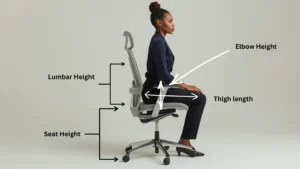
Write these four numbers down. They are your personal chair blueprint, and they make every comparison in this guide concrete rather than guesswork.
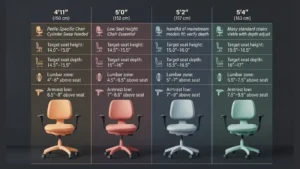
Ideal Chair Specs by Height (4’11” to 5’4″)
Individual proportions vary — a 5’2″ woman with a longer torso and shorter legs needs different specs than a 5’2″ woman with a longer inseam. That said, the measurements below represent reliable midpoint targets based on anthropometric data published by sources like the Centers for Disease Control and Prevention (CDC), anthropometric reference data, and the Human Factors and Ergonomics Society. Your personal measurements from the section above should take priority, but these ranges give you a quick way to filter chairs before diving deeper.
4’11” (150 cm) Target seat height: 14.0″–15.0″. Target seat depth: 14.5″–15.5″. Lumbar support zone: 4″–6″ above seat. Armrest low point: 6.5″–8″ above seat. Finding an office chair for petite women at this height is genuinely difficult — most chairs start at 16″ seat height. You’ll likely need a petite-specific cylinder swap or a chair explicitly designed for smaller frames.
5’0″ (152 cm) Target seat height: 14.5″–15.5″. Target seat depth: 15″–16″. Lumbar support zone: 4.5″–6.5″ above seat. Armrest low point: 7″–8.5″ above seat. A low seat height office chair becomes essential here. Look for models advertising a minimum seat height at or below 15.5″.
5’2″ (157 cm) Target seat height: 15.0″–16.0″. Target seat depth: 15.5″–16.5″. Lumbar support zone: 5″–7″ above seat. Armrest low point: 7″–9″ above seat. This is the most common height range in our audience, and it’s where the selection opens up slightly. A chair for a 5’2″ woman can work from a handful of mainstream models — as long as you verify the seat depth. That’s where most “almost fits” chairs fall short.
5’4″ (163 cm) Target seat height: 15.5″–16.5″. Target seat depth: 16″–17″. Lumbar support zone: 5.5″–7.5″ above seat. Armrest low point: 7.5″–9.5″ above the seat. At this height, many standard chairs become viable if they offer seat depth adjustment. The primary concern shifts from seat height to ensuring the backrest curvature and lumbar pad hit the right zone.
Top Features That Matter Most
Not every adjustment feature on an office chair carries equal weight for petite users. Here’s a ranked breakdown of what to prioritize — and what’s fine to skip if budget is a concern.
1. Seat Height Range (Non-Negotiable) This is the single most important spec. If the chair’s minimum seat height exceeds your popliteal measurement by more than half an inch, the chair doesn’t fit. Period. No cushion, no footrest fully compensates for a seat that’s simply too high. When shopping, look for the manufacturer’s listed minimum seat height with the pneumatic cylinder fully compressed. Some brands offer a “short cylinder” or “petite cylinder” as a factory option or aftermarket upgrade — this can drop the minimum by 1″–2″ and is often the simplest way to make a good chair into the best chair for short women in its class.
2. Seat Depth Adjustment (Critical) A seat depth slider lets you move the seat pan forward or back relative to the backrest. This is far more effective than simply buying a “small” chair, because it lets you maintain full backrest contact while keeping pressure off the backs of your knees. If a chair offers a seat depth range that goes down to 15.5″ or less, it’s a strong candidate. Chairs without seat depth adjustment need to have a fixed depth under 17″ to be considered petite-friendly.
3. Lumbar Support Height Adjustment (Highly Important) A lumbar pad that slides up and down on the backrest allows you to position support exactly where your spine needs it. Fixed lumbar support works only if it happens to land in the right zone for your torso length. Adjustable is always better, but verifiable fixed placement in the 4″–7″ range above the seat is acceptable.
4. Backrest Height or Recline Range (Important) A backrest that’s too tall can push a petite user’s head forward, especially if it includes a fixed headrest. Look for backrests that either terminate below your head or include a removable, adjustable headrest. Recline tension should be adjustable — many chairs ship with recline tension calibrated for a 170-pound user, making the tilt stiff and unresponsive for someone at 110–130 pounds.
5. Armrest Adjustability (Important) 4D armrests (height, width, depth, angle) are ideal but not always necessary. At a minimum, you need height-adjustable armrests that go low enough to let your elbows rest without shoulder shrugging. Width adjustment is a bonus — narrower armrest spacing keeps elbows closer to the body, which is more natural for narrower frames.
6. Seat Pan Tilt (Nice to Have) A forward seat tilt (sometimes called “negative tilt”) angles the seat pan slightly downward at the front. This opens the hip angle and can improve comfort for petite users who find themselves perched at the front edge of the seat. It’s a meaningful feature but not a dealbreaker.
7. Aesthetic and Material Choices (Personal) Mesh, fabric, and leather each have trade-offs in breathability, durability, and feel. None is inherently better for petite users. Choose based on your climate, your style preferences, and how your broader home office furniture aesthetic comes together. Mesh tends to run cooler; fabric cushions tend to feel softer initially but may compress over time.
Best Chairs by Budget (Budget / Mid-Range / Premium)
Every chair below has been evaluated against the petite-specific criteria outlined above. We’re looking at real published dimensions, not marketing claims. Where a petite cylinder or configuration is required, we note it explicitly.
Budget: Under $300
HON Ignition 2.0 (Low-Profile Cylinder) The Ignition 2.0 is a workhorse. With the low-profile cylinder option, the minimum seat height drops to approximately 15.5″, which works for women 5’1″ and above. Seat depth adjustment is standard across all configurations, allowing the depth to reach about 16″. Lumbar support is integrated into the backrest shape rather than as a separate adjustable pad, but the curvature lands well for shorter torsos. The mesh back breathes well, and the overall build quality significantly exceeds its price point. The armrests are height-adjustable but lack width or depth adjustment. For a daily driver under $300, this is hard to beat.
Hbada Ergonomic Office Chair (Petite Model) Hbada has gained traction in the direct-to-consumer space, and their petite-oriented model advertises a minimum seat height of approximately 15.75″ and a seat depth of around 16.5″. It includes a flip-up armrest design, which is useful for tucking the chair under shorter desks. Build quality is a step below the HON, and the lumbar support is a fixed pad rather than adjustable, but the price (often under $200) makes it a reasonable entry point, particularly for a secondary workspace.
What to Watch For at This Price: Chairs under $200 frequently list misleading seat height specs that measure from the floor to the seat front rather than to the compressed seating surface. Always look for “seat height measured from floor to top of cushion, compressed” in the spec sheet. If that data isn’t available, treat the listed number as optimistic by about 0.5″–1″.
Mid-Range: $300–$600
Steelcase Leap (Petite Cylinder) The Leap is widely regarded as one of the best task chairs ever made, and for good reason — its “LiveBack” technology flexes with your spine as you move, and the seat depth slider offers a range that bottoms out near 15.5″. The standard cylinder has a minimum seat height around 15.75″, but Steelcase sells a petite cylinder (sometimes listed as “5” cylinder” or “short cylinder”) that brings the minimum to approximately 14.5″. This makes it viable even for women at 4’11”. The recline tension adjusts with a simple dial, and it goes light enough for users well under 150 pounds. If you spend six or more hours a day seated, this is likely the best ergonomic chair petite women in the mid-range can access.
Steelcase Series 1 (Small Frame): A more affordable entry into the Steelcase ecosystem. The Series 1 doesn’t offer quite the same seat depth range as the Leap, but its compact frame, adjustable lumbar, and sub-16″ minimum seat height make it a legitimate option for women 5’1″ and taller. The weight-activated recline mechanism is genuinely responsive at lower body weights, which is a common failure point in other chairs.
Humanscale Diffrient World Humanscale’s design philosophy minimizes manual adjustments in favor of automatic, weight-responsive mechanisms. The Diffrient World uses your body weight to calibrate recline tension, which is a major advantage for lighter users who are constantly fighting stiff-tilt chairs. The seat height range starts at approximately 15.5″, and the mesh seat distributes pressure evenly. The seat depth is fixed at about 16.5″, which limits its range for the shortest petite users but works well for 5’1″ and above. If you prefer a clean, minimalist look in your office chair collection, this one delivers.
Premium: $600+
Herman Miller Aeron (Size A) The Aeron’s three-size system (A, B, C) is one of the few mainstream approaches that acknowledges body size variation directly. Size A is built for users approximately 4’10″–5’4″ and under 150 pounds. The minimum seat height is approximately 15″, the seat depth is fixed at about 15.75″ (well within the petite range), and the PostureFit SL lumbar support is adjustable in both height and pressure. The full mesh construction eliminates cushion compression concerns, and the seat surface stays consistent from day one through year ten. It’s a premium investment, but it’s also a chair that holds 50–60% of its value on the resale market years later.
Herman Miller Sayl: A more accessible Herman Miller option, the Sayl features an unframed backrest with a Y-Tower suspension system that adapts to different spine curvatures. The minimum seat height with the standard cylinder reaches about 15.5″, and a short cylinder option can reduce this further. Seat depth is adjustable on some configurations. It’s visually striking, lighter than the Aeron, and well-suited for petite users in the 5’0″–5’4″ range who want Herman Miller build quality without the Aeron’s price.
Steelcase Gesture (Petite Cylinder) The Gesture is designed around the concept of supporting multiple postures — upright typing, leaning back on a phone call, perching forward to sketch. Its 360-degree armrest system is the most flexible on the market, and the seat depth slider brings the effective depth below 16″. With a petite cylinder, the seat height drops to approximately 14.5″. The Gesture’s broad appeal means it’s a strong choice if multiple people of different sizes share a workspace, but configured specifically for a petite user, it performs at the same level as the Leap.
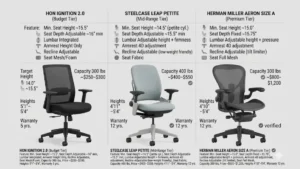
Side-by-Side Comparison Table
| Feature | HON Ignition 2.0 | Steelcase Leap (Petite) | Herman Miller Aeron (Size A) |
|---|---|---|---|
| Min. Seat Height | ~15.5″ | ~14.5″ (petite cyl.) | ~15.0″ |
| Seat Depth | Adjustable, ~16″ min | Adjustable, ~15.5″ min | Fixed, ~15.75″ |
| Lumbar Support | Integrated (fixed curve) | Adjustable height + firmness | Adjustable height + pressure |
| Armrest Adjustment | Height only | Height, width, depth, pivot | Height, width, depth, pivot |
| Recline Tension | Adjustable | Adjustable (low-weight friendly) | Adjustable (tilt limiter) |
| Seat Material | Mesh back / foam seat | Fabric or leather seat | Full mesh |
| Weight Capacity | 300 lbs | 400 lbs | 300 lbs (Size A) |
| Approx. Price | $250–$300 | $400–$550 (configured) | $800–$1,200 |
| Best For Heights | 5’1″–5’4″ | 4’11″–5’4″ | 4’10″–5’4″ |
| Warranty | 5 years | 12 years | 12 years |
Note: all dimensions are approximate and based on manufacturer-published specifications as of early 2026. Always verify against current listings, as manufacturers occasionally update cylinder lengths or cushion profiles between production runs.
Setup Checklist After Purchase
Buying the right chair is half the equation. Setting it up correctly is the other half. Use this checklist the day your chair arrives — it takes about ten minutes and makes a measurable difference in comfort from the first session.
Step 1: Adjust Seat Height. First, sit with your feet flat on the floor (no shoes). Lower the seat until your thighs are parallel to the ground or angled very slightly downward toward your knees. If you can’t achieve flat feet at the chair’s lowest setting, you need a lower cylinder or a footrest (a firm, angled footrest — not a stack of books). Confirm this before adjusting anything else, because every other setting depends on your seat height being correct.
Step 2: Set Seat Depth Slide the seat pan so there’s a gap of two to three finger-widths (about 1.5″–2.5″) between the front edge of the seat and the back of your knees. You should feel the backrest making solid contact with your lower back simultaneously. If you can’t achieve both, the chair’s seat depth range may not be right for your proportions.
Step 3: Position Lumbar Support Adjust the lumbar pad (or the entire backrest height, on chairs that allow it) until the supportive pressure lands in the inward curve of your lower spine. You should feel gentle support — not a hard push. The goal is to help your spine maintain its natural S-curve without effort.
Step 4: Adjust Armrests Lower the armrests until your elbows rest on them at approximately 90 degrees with your shoulders completely relaxed — not hiked up, not reaching down. If the armrests can’t go low enough, remove them entirely; bad armrest height is worse than no armrests at all.
Step 5: Calibrate Recline Tension. Lean back. The backrest should move with you using moderate effort — not so stiff that you feel like you’re pushing against a wall, and not so loose that it collapses backward. Most chairs have a tension knob (usually under the seat). Turn it until the recline feels natural and supportive at your body weight.
Step 6: Check Monitor and Desk Relationship. Your chair doesn’t exist in isolation. With the chair properly set, your eyes should be level with the top third of your monitor, and your desk height should allow your forearms to rest parallel to the floor while typing. If your desk is too high after setting your chair correctly, consider a keyboard tray or an adjustable-height desk. Optimizing your home office lighting at this stage also helps reduce eye strain and forward-leaning posture that undoes your chair setup.
Step 7: Reassess After One Week. Your body needs a few days to adapt to a properly fitted chair, especially if you’ve been sitting in a poorly fitted one for months or years. After five to seven business days, revisit each setting above and make micro-adjustments. Many people find they want the lumbar support slightly higher or the seat depth slightly shorter than their initial setup.

Chair Setup Checklist for Petite Women
FAQ
How do I know if an office chair is truly petite-friendly?
Check three numbers in the spec sheet: minimum seat height (should be 15.5″ or lower, ideally 15″ or lower), minimum seat depth (should reach 16.5″ or less, ideally under 16″), and lumbar support placement range. If any of those specs are missing from the product page, contact the manufacturer directly. Reputable brands will provide exact measurements. Vague terms like “adjustable for all body types” without published numbers are a red flag.
Can I just use a footrest instead of buying a shorter chair?
A footrest is a workaround, not a solution. It addresses the symptom (dangling feet) but not the root cause (a seat pan that’s too high relative to your body). When you use a footrest, your thigh angle changes, which can increase pressure on the underside of your thighs and shift your pelvis backward. If you’re using a footrest to compensate for more than 1.5″ of excess seat height, the chair is simply too tall. A footrest works well as a fine-tuning tool for small gaps — not as a substitute for proper seat height.
What’s the difference between a “small” chair and a “petite-configured” chair?
A “small” chair typically means a compact overall footprint — narrower seat, shorter backrest, lighter weight capacity — but may still use a standard-height gas cylinder. A petite-configured chair starts with a standard high-quality frame and swaps in a shorter cylinder, sometimes paired with a shallower seat pan. The petite configuration approach usually delivers better ergonomic support because the underlying mechanism is more sophisticated. Always verify the minimum seat height regardless of how the chair is labeled.
Are mesh or cushioned seats better for petite women?
Neither is inherently better for petite body types. Mesh seats distribute weight evenly and don’t compress over time, which means the effective seat height stays consistent for years. Cushioned seats may feel softer initially but compress with use, which can gradually raise your effective seat height by 0.5″–1″ as the foam wears down. If you prefer cushioning, look for high-density foam rated for long-term use, and be prepared to reassess your seat height setting annually.
How important is the chair’s weight capacity rating for petite users?
The weight capacity number itself is less relevant for petite women (you’re well under any reasonable limit), but it signals something important: how the recline mechanism is calibrated. A chair rated for 250–400 pounds often ships with a recline tension set for a much heavier user, and the adjustment range may not go light enough for someone at 110–135 pounds. The Steelcase Leap and Humanscale Diffrient World both handle this well; many budget chairs do not.
Can I make a standard office chair work if I’m under 5’2″?
Sometimes, with modifications. Swapping the gas cylinder for a shorter one (widely available aftermarket for $30–$60) is the most impactful single change. Adding a separate lumbar pillow can help if the built-in support is too high. Replacing the seat cushion with a shorter, firmer aftermarket cushion can improve seat depth. But these modifications have limits — if the chair’s backrest curvature, armrest range, and recline tension are all wrong for your frame, no amount of accessories will fully compensate. It’s usually more cost-effective to invest in the right chair from the start.
How often should I replace my office chair?
For a high-quality ergonomic chair used eight hours a day, the mechanical components (cylinder, tilt mechanism, casters) typically last 7–12 years. Foam cushions degrade faster, usually showing meaningful compression at the 3–5 year mark. Mesh seats last longer. If you notice your feet no longer rest flat despite not changing your settings, cushion compression may have effectively raised your seat height — a sign it’s time for at least a cushion replacement if not a new chair.
Does chair color or style affect ergonomic performance?
No, but it affects whether you’ll actually use the chair consistently. If a chair looks out of place in your workspace or clashes with your aesthetic preferences, you’re more likely to swap it out for something less supportive or gravitate toward working from the couch. Choose a chair that fits your body first, then your space. Most premium ergonomic chairs offer multiple colorways and upholstery options precisely for this reason. When you’re curating your full home office furniture setup, a cohesive look contributes to a workspace you actually want to sit down in every morning.
Final Recommendations
Choosing the right ergonomic chair for petite women can rely on daily comes down to matching specific dimensions to your specific body. The process isn’t complicated once you have your four key measurements, but it does require ignoring the one-size-fits-all marketing that dominates the office furniture industry.
If you’re on a tight budget and you’re 5’1″ or taller, the HON Ignition 2.0 with a low-profile cylinder gives you legitimate seat depth adjustment and a reasonable seat height range for under $300. It’s a smart, practical purchase that solves the most common petite-fit issues.
If you’re investing in a chair for full-time daily use and you want the widest adjustment range across the entire 4’11″–5’4″ spectrum, the Steelcase Leap with a petite cylinder is the strongest all-around choice. Its seat depth slider, low-weight recline calibration, and proven long-term durability make it the chair most likely to feel right on day one and still feel right in year eight.
If you want the best possible build quality, don’t mind a fixed (but well-proportioned) seat depth, and appreciate a chair that requires almost zero ongoing adjustment, the Herman Miller Aeron Size A is the benchmark. Its full-mesh construction means no cushion degradation, no seat height drift, and no material breakdown for a decade or more.
Whichever direction you go, the fundamentals remain the same: get your feet flat, get your seat depth right, get your lumbar support in the right zone, and revisit your setup after the first week. These basics, grounded in established ergonomic guidelines from organizations like OSHA and the Human Factors and Ergonomics Society, apply regardless of brand or budget.
Your chair is the single most-used piece of equipment in your workspace. For petite women, the gap between a chair that “sort of works” and one that genuinely fits is the difference between ending each workday in discomfort and barely thinking about your chair at all. The second option is what you deserve — and with the right specs, it’s entirely achievable.
For more guidance on building a workspace that supports your body and your workflow from every angle, explore the full home office resource hub and start with the tools that match where you are right now. Your chair is the foundation. Build from there.