
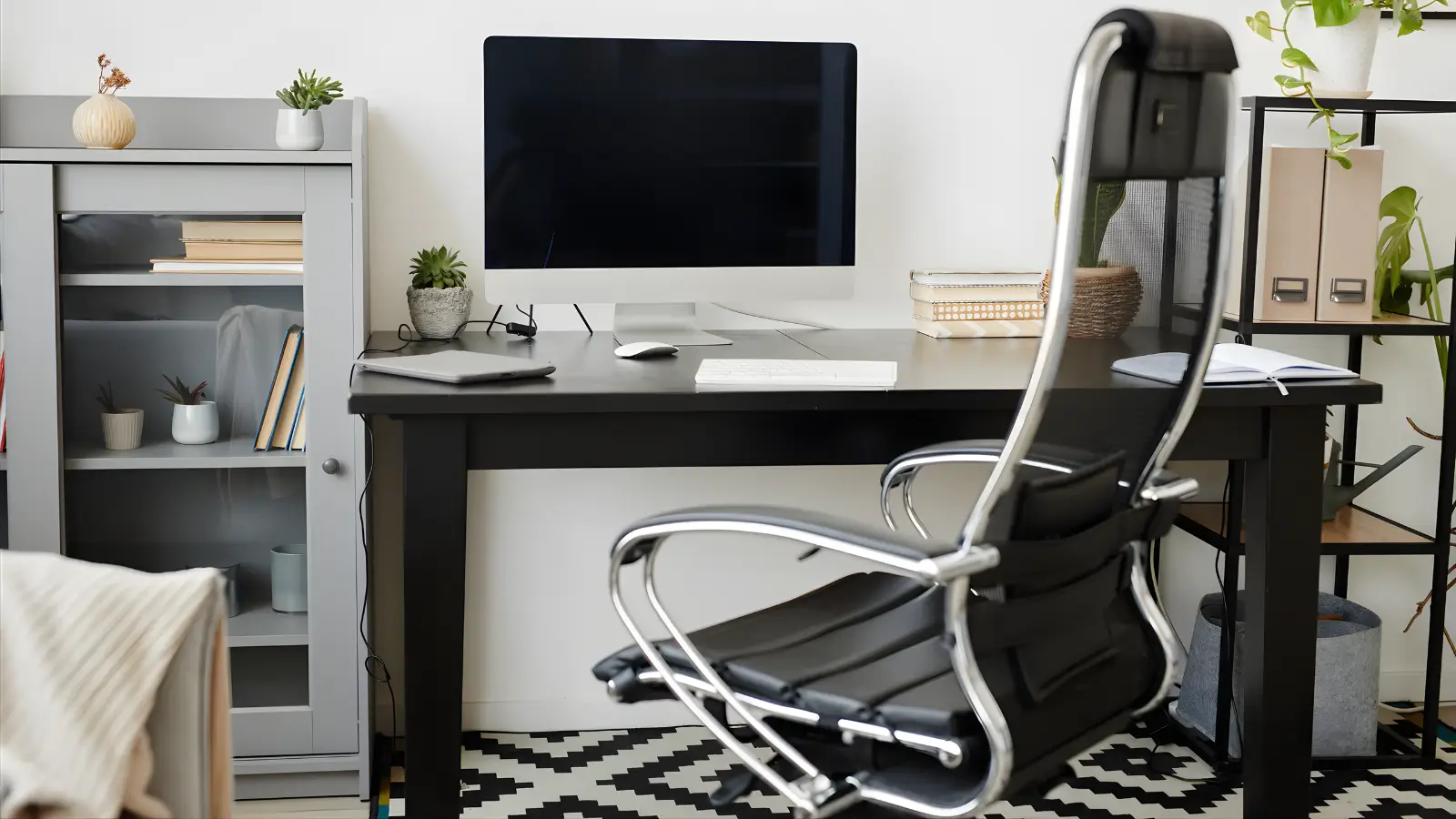

If your office chair leaves you fidgeting by noon, you are not alone — and the problem almost certainly is not you. The majority of office chairs for women on the market today are still engineered around male body proportions: a 5′10″, 175-pound reference figure with a narrower pelvis, shallower lumbar curve, and longer thigh-to-lower-leg ratio. When you are shorter, wider through the hips, or simply shaped differently from that blueprint, no amount of “ergonomic” labelling on the box will save your lower back.
This guide cuts through the marketing noise. We will walk through the anatomical reasons women need different chair criteria, the exact features that matter — from seat depth and lumbar position to armrest range — and then match those features to your body type, whether you are petite, tall, plus-size, or somewhere in between. Along the way, you will find style guidance to make sure your chair belongs in your home office, a step-by-step setup process, and answers to the questions women ask most. No brand names, no product rankings — just the information you need to sit well and feel good doing it.
Introduction — Why Many Chairs Don’t Fit Women
Walk into any office furniture showroom, and you will notice a pattern: nearly every chair is built to a single size standard. That standard is derived from anthropometric data sets that skew male, collected decades ago, and rarely updated to reflect the diversity of bodies that actually sit in them eight hours a day. The result is a generation of seating that treats the female body as a smaller version of the male body — scaling things down instead of redesigning them.
The stakes are not trivial. A chair that is too deep forces you to perch at the edge, abandoning lumbar support entirely. Armrests set too wide let your elbows drift outward, pulling your shoulders into a hunch. A seat pan that sits too high at its lowest setting leaves your feet dangling, cutting circulation behind your knees. Over weeks and months, these small mismatches compound into chronic lower-back pain, hip stiffness, neck tension, and the kind of creeping fatigue that drains productivity long before the workday ends.
The good news is that once you understand what your body actually requires — and why — choosing the right ergonomic office chair for women becomes straightforward. In the sections that follow, we move from anatomy to actionable advice: the features to prioritise, the numbers to check, the setup steps to follow, and the style choices that ensure your chair looks as intentional as the rest of your workspace. Consider this your non-negotiable reference before you ever add a chair to a cart.
Why Women’s Bodies Need Different Chair Criteria
Understanding the anatomy behind the discomfort is not an academic exercise — it is the fastest route to knowing exactly which specifications to look for on a product page. Four key structural differences between female and male bodies drive almost every chair-fit issue women encounter.
Lumbar Curvature (Lordosis)
Research published in the Journal of Orthopaedic & Sports Physical Therapy found that women’s lumbar curvature angle is, on average, 13.2 degrees greater than men’s. In plain language, the inward curve of your lower back is more pronounced. A chair whose lumbar pad is fixed at a position calibrated for a flatter male spine will either push into the wrong spot or miss your curve entirely, leaving your lower back unsupported. This is why adjustable lumbar height — not just lumbar depth — is critical for women.
Pelvis Shape and Hip Width
The female pelvis is wider and shallower than the male pelvis, designed to accommodate childbirth. This means your sit bones (ischial tuberosities) are farther apart, and your centre of gravity sits lower. A seat pan that is too narrow concentrates pressure on the outer edges of those sit bones, while one that is too flat may not distribute weight evenly across a wider base. At the same time, the wider pelvis shifts hip-to-shoulder ratios: women tend to have narrower shoulders relative to their hips, which makes standard armrest spacing — designed for broader male shoulders — feel too wide, encouraging the elbows-out, shoulders-up posture that leads to neck and trapezius pain.
Thigh Length and Seat Depth
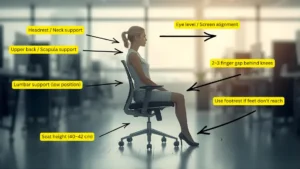
Women generally have proportionally shorter upper legs (femurs) compared to their overall height. When a seat pan is 50 cm deep — common in standard office chairs — a woman of average height may find the front edge pressing into the backs of her knees, restricting blood flow and causing numbness. The fix is a shorter or adjustable seat depth, ideally letting you maintain a gap of two to three finger-widths between the seat edge and your knee crease while still sitting fully back against the lumbar rest.
Height Distribution and Lower Leg Length
The average height for women in the United States is roughly 5′4″ (163 cm), compared with about 5′9″ (175 cm) for men. But it is not just overall height that matters — it is how that height is distributed. Women tend to carry a greater proportion of height in their torso relative to leg length, which affects how seat height, backrest height, and headrest position should be calibrated. A chair that only adjusts down to 45 cm at its lowest may still be too high for a woman who is 5′2″, leaving her feet unsupported and her thighs angled uncomfortably downward.
When you translate these four anatomical realities into chair specifications, a clear checklist emerges: you need a lower minimum seat height, a shallower (or adjustable) seat depth, a wider seat pan, lumbar support that adjusts both vertically and in depth, armrests that come in narrower than standard, and a backrest contour that respects a more pronounced lumbar curve. The next section turns that checklist into concrete, measurable features.
What to Look For in an Office Chair for Women
Shopping for a woman’s office chair is easier when you know the specific features that address female anatomy and the measurable benchmarks each feature should meet. Below is a scannable feature-by-feature breakdown. Use it as a reference card when comparing any chair — online or in person.
Seat Height Range
This is arguably the single most important specification for women, especially those on the shorter side. You want the chair’s gas lift to go low enough that your feet rest flat on the floor (or on a footrest) with your hips at roughly the same height as — or very slightly above — your knees. For an office chair for petite women (under 5′4″), look for a minimum seat height starting around 40–42 cm (roughly 15.7–16.5 inches). Chairs that only drop to 45 cm or higher will leave shorter women dangling, which defeats every other ergonomic feature.
Seat Depth
The office chair seat depth for women should allow you to sit with your back fully against the lumbar rest while keeping two to three finger-widths of clearance between the front edge of the seat and the backs of your knees. For most women, this translates to a usable seat depth of roughly 38–46 cm (15–18 inches). An adjustable sliding seat pan is the gold standard because it lets you fine-tune depth as you shift postures throughout the day. If the chair does not offer adjustable depth, err on the shallower side.
Seat Width
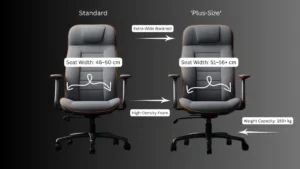
Seat width needs to accommodate the wider female pelvis without being so wide that your arms cannot comfortably reach the armrests. A seat pan of roughly 45–51 cm (17.5–20 inches) works for most women of average build. Office chair for plus-size women considerations push that range wider — 51–56 cm (20–22 inches) or beyond — and we discuss this in detail in the body-type section below.
Lumbar Support
Because women’s lumbar lordosis is more pronounced and sits at a slightly different vertebral level than men’s, a chair with adjustable lumbar support for women should offer both height adjustment and depth (or firmness) adjustment. Height adjustment lets you slide the lumbar pad up or down to match where your curve actually falls — for shorter women, that tends to be lower on the backrest than the factory default. Depth adjustment lets you control how far the pad pushes into your spine, preventing the over-correction that can feel just as uncomfortable as no support at all.
Armrests
Look for at least 3D-adjustable armrests — height, width, and angle — with 4D (adding fore-and-aft sliding) being ideal. The critical metric for women is width: you want the pads close enough to your torso that your elbows rest at approximately 90 degrees with your shoulders completely relaxed, not hiked up or splayed outward. If the minimum width setting on a chair still feels too far apart for your frame, consider whether the armrests can be removed entirely and replaced with a narrower aftermarket set, or whether you would be better off with an armless design paired with a properly height-matched desk.
Backrest Shape and Height
The backrest should support the natural S-curve of your spine without pressing into your shoulder blades. For shorter women, a mid-back chair (backrest height around 50–55 cm) often fits better than a full high-back design, which can push the headrest into the upper back rather than the head. Taller women benefit from a high-back or headrest-equipped design, provided the lumbar zone still aligns with their lower curve.
Materials
Material choice is more than aesthetics — it affects temperature regulation, which many women cite as a comfort priority. Breathable mesh keeps you cooler during long sessions and tends to require less maintenance, while upholstered foam offers a plusher feel and a wider palette of textures (bouclé, linen-look, velvet) that integrate into home office décor. If you run warm or live in a hot climate, prioritise mesh or hybrid designs. If you want the chair to feel like furniture rather than equipment, upholstered seats with a mesh back offer a practical middle ground.
Weight Capacity and Build Quality
Check the rated weight capacity against your actual weight — and then add a margin for safety and longevity. A chair rated for 120 kg (265 lbs) will degrade faster if you are consistently at 110 kg than one rated for 150 kg. Beyond the number, look at the base material (aluminium or reinforced nylon over basic plastic), the caster type (rubber-coated for hard floors, standard for carpet), and the gas lift quality (class 3 or class 4).
Movement and Tilt
Dynamic seating — the ability to rock, recline, or shift the seat angle — reduces static load on your spine and engages stabiliser muscles that would otherwise go dormant. A synchro-tilt mechanism, which reclines the backrest and tilts the seat in a coordinated ratio, is generally preferable to a single-lever recline. A slight forward-tilt option (tilting the seat pan a few degrees downward at the front) can be especially helpful for women who experience lower-back fatigue or sciatica, because it encourages a more neutral pelvic position.
Aesthetic Form Factor
If you work from home, the chair is part of your room’s visual story. We cover style in its own section below, but the key principle is this: ergonomics and aesthetics are not mutually exclusive. Slim-profile bases, fabric choices that go beyond black mesh, and clean silhouettes are all available in chairs that also check every adjustment box. Prioritise function first, then narrow your shortlist by appearance — never the reverse.
Fit by Body Type — Principles and Ranges
No single set of dimensions works for everybody. The guidance below provides measurement ranges and fit principles for five common scenarios. Use them as a starting-point filter, then fine-tune once you are in the chair.
Petite Women (Under ~5′4″ / ~163 cm)
Finding the right office chair for short women is often the most frustrating shopping experience because so few chairs go low enough or shallow enough. Your primary targets are a minimum seat height of roughly 40–42 cm, a seat depth of roughly 38–44 cm (or an adjustable slider that reaches that range), and lumbar support that adjusts low enough to contact your lower back without riding up to mid-back. Armrests should be lowered to at least desk-surface height for compact desks, and ideally come in narrow enough that you are not reaching sideways.
If a chair meets every criterion except seat height, a high-quality footrest can bridge the gap — but only if the rest of the dimensions still align. Pairing a too-deep seat with a footrest trades one pressure point for another. Many petite women also prefer a mid-back chair rather than a high-back, because the headrest on a full-size chair often hits at the neck or upper-back level rather than where it should.
Average Height (5′4″–5′8″)
Women in this range have the widest selection of chairs that can be adjusted to fit, but “can be adjusted” is the operative phrase — do not assume a standard chair will fit out of the box. Your focus should be on ensuring the lumbar pad actually contacts your lower back rather than your mid-back, since many chairs ship with the lumbar set at a male-average height. A seat depth of roughly 42–48 cm with the slider adjusted so that the two-to-three-finger clearance rule is met will serve most women in this height bracket.
Armrest height should let your forearms rest level with or very slightly above your desk surface, keeping elbows at roughly 90 degrees and shoulders down and relaxed. If you pair your chair with a home office desk for women that has adjustable height, you gain even more fine-tuning flexibility between the two surfaces.
Tall Women (5′8″+)
Tall women face the opposite problem from petite women: not enough seat depth, not enough backrest height, and armrests that do not rise high enough to support forearms at the correct angle relative to a standard-height desk. Look for a seat depth of 48 cm or more (an adjustable slider is especially useful here), a high-back chair with an integrated or adjustable headrest, and armrests that extend to at least 28–30 cm above the seat pan. A taller gas lift range — topping out above 55 cm — ensures your hips-to-knees angle stays neutral even with long femurs.
The lumbar pad should still sit in the lower-back curve, but for taller women, that curve is higher on the backrest. Verify that the lumbar adjusts upward sufficiently; some chairs marketed as “ergonomic” have surprisingly limited vertical travel.
Plus-Size Women
An office chair for plus-size women needs to address width, weight capacity, and foam density simultaneously. Start with a seat pan at least 51 cm (20 inches) wide — many plus-size-friendly options go to 56 cm or wider. The foam (or suspension mesh) should be high-density to avoid bottoming out, which not only feels uncomfortable but also eliminates the seat’s ability to distribute pressure evenly.
Weight capacity should be rated at a minimum of 135 kg (300 lbs), ideally 150 kg or more, with a reinforced aluminium or steel base and heavy-duty casters. Armrest spacing matters doubly here: armrests that are too narrow feel confining, while arms that flip up or remove entirely offer useful flexibility. A wider-than-standard backrest ensures your torso is fully supported without the edges digging into your sides.
If You Sit Cross-Legged or Leg-Over-Leg
Many women naturally cross their legs, tuck a foot underneath them, or shift into asymmetric postures throughout the day. Fighting this instinct entirely is not realistic — but you can choose a chair that accommodates it without causing harm. A wider, flatter seat pan with a gently rounded or waterfall front edge gives your knees room to shift without pressing against sharp corners. Armless chairs or chairs with flip-up armrests remove the barriers that make cross-legged sitting awkward.
That said, habitual leg-crossing creates uneven hip and pelvic loading over time, so the best strategy is to alternate between crossed and uncrossed positions. A chair with easy-to-access tilt or dynamic movement encourages you to change postures frequently, reducing the cumulative strain of any single position. If you spend long hours cross-legged, pay particular attention to seat cushion firmness — soft foam compresses unevenly under asymmetric weight, while medium-firm foam or mesh maintains more consistent support.
Budget Planning (Without Brands)
How much you spend on a chair determines primarily two things: the number of adjustable features and the longevity of the materials. Understanding what increases at each price level helps you allocate your budget toward the adjustments that matter most for your body.
At the budget level (roughly under $200–$250), you will typically find pneumatic height adjustment, a fixed or minimally adjustable lumbar pad, basic tilt, and non-adjustable armrests. These chairs can work for short stints, but the lack of seat-depth adjustment and limited lumbar customisation means you are relying on add-on cushions or footrests to close the fit gap. Foam quality at this tier tends to compress within 12–18 months.
At the mid-range level ($250–$600), adjustable seat depth, height-adjustable lumbar, and 3D or 4D armrests become common. Materials improve — higher-density foam, breathable mesh, aluminium bases — and warranties extend to three to five years. For most women working from home full-time, this tier offers the best value because it provides the critical adjustability points that align a chair to female anatomy without requiring a four-figure investment.
At the investment level ($600 and above), you gain premium synchro-tilt mechanisms, auto-adjusting lumbar systems, 12–15-year warranties, sustainable materials, and the level of build quality that withstands eight-plus hours of daily use for a decade. If your budget allows it, the long-term cost per year often works out lower than replacing a budget chair every two years.
Regardless of tier, prioritise your spending in this order: adjustability first (seat height, depth, lumbar, and armrests), then material durability (foam density, base construction, caster quality), and finally aesthetics (colour, finish, fabric type). A perfectly styled chair that lacks seat-depth adjustment will always be a worse investment than a plain-looking chair that fits your body.
Style and Aesthetics — Chairs That Belong in a Feminine Home Office
Your workspace should feel like yours. If you have invested time curating an aesthetic home office or creating a cozy home office, the last thing you want is a chair that looks like it was borrowed from a corporate IT department. The good news is that ergonomic chairs have moved well beyond the black-mesh-on-plastic-base formula, and you can find options that check every functional box while fitting naturally into a designed space.
The key is to narrow by silhouette and then by finish. Slim-profile frames with tapered legs or a five-star base in polished aluminium or warm-toned wood caps read as furniture rather than equipment. Fabric choices — bouclé, linen-look weaves, soft-touch velvet, or tonal mesh in cream, sage, terracotta, or charcoal — let the chair participate in your colour story instead of interrupting it.
To match specific interior styles, think of it this way. A minimalist or modern space pairs well with monochrome mesh or matte-finish frames in white, grey, or black — the chair should almost disappear into the room. A soft, feminine room (blush walls, gold accents, natural light) calls for upholstered seats in cream, dusty rose, or warm taupe with brushed metal or light wood accents. A moody or dark academia study works with deep-toned leather-look fabrics, dark walnut caps, and heavier visual weight. A boho or natural space benefits from woven-texture fabrics, organic curves, and warm wood bases. A Japandi office — clean lines, muted earth tones, craft sensibility — suits a low-profile chair in oatmeal or stone with a minimal aluminium base.
In small-space setups, where the chair doubles as a visual centrepiece, consider how it interacts with your desk décor and wall décor. A compact, upholstered chair in a complementary accent colour can anchor the corner without overwhelming it, especially when paired with space-saving furniture that keeps sightlines open.

Special Situations
Pregnancy and Postpartum
Pregnancy shifts your centre of gravity forward as the baby grows, increasing lumbar lordosis and placing extra load on the lower back. A chair that worked perfectly at 12 weeks may feel unbearable by 30 weeks. The features that matter most during pregnancy are a responsive lumbar support that can be repositioned daily as your posture changes, a seat pan that tilts slightly forward to reduce pressure on the pelvis, and armrests you can adjust with one hand for quick micro-corrections when you shift positions.
Seat depth becomes more important as well: as the abdomen grows, you may instinctively sit farther forward, abandoning the backrest. A seat-depth slider lets you shorten the pan to follow you forward while maintaining lumbar contact. After delivery, many women experience weakened core muscles and pelvic-floor fatigue that make prolonged sitting harder. During the postpartum period, a slightly reclined backrest angle (100–110 degrees) and a dynamic tilt that lets you rock gently can reduce strain while your body recovers. If you are nursing at your desk, armrests that lower fully — or flip up entirely — provide the freedom you need.
Back Pain, Sciatica, and Hip Pain
If you are already experiencing lower-back or hip pain, the chair alone will not fix it — but the wrong chair will absolutely make it worse. Consistent lumbar contact is the non-negotiable starting point: your back should rest against the lumbar pad whenever you are seated, not only when you consciously correct your posture. Adjustable seat depth keeps pressure off the sciatic nerve at the back of the thigh, and a forward-tilt option encourages a neutral pelvic position that reduces disc compression.
Dynamic movement is equally important. A synchro-tilt mechanism that lets you shift between upright and reclined positions throughout the day relieves static loading and reduces muscle fatigue. If your sciatica flares on one side, check that the seat pan is wide and flat enough to let you shift weight subtly without perching on a corner. And remember: a chair is one element of an ergonomic system. Pair it with a properly positioned monitor, keyboard, and mouse — and take movement breaks every 30 minutes — for the best results.
Hot Climates and Heat Sensitivity
Hormonal fluctuations, metabolism differences, and simple climate realities mean many women run warm at their desks. If that is you, mesh is your friend — both in the backrest and, if possible, in the seat. Full-mesh designs allow airflow on all contact surfaces and eliminate the trapped-heat feeling that upholstered foam creates after an hour of sitting. Where a full mesh feels too firm, a mesh-back with a ventilated or perforated foam seat offers a compromise.
Beyond material, lighter colourways reflect more ambient heat than dark ones (relevant if your chair sits in direct sunlight), and chairs with open-frame bases allow air to circulate underneath the seat. If you love the look of upholstered fabric but cannot tolerate the heat, look for chairs with moisture-wicking or cooling-gel-infused seat cushions — features that have become more common across mid-range options.
Step-by-Step: Adjust Your Chair for Your Body
Owning a well-specified chair is only half the equation. A chair that is not properly adjusted to your body is no better than one that does not adjust at all. Follow these eight steps — in order — the first time you sit down, and revisit them any time you change desks, shoes, or work surfaces.
- Set seat height. Sit with your feet flat on the floor (or on a footrest if you cannot reach). Adjust the gas lift until your hips are at approximately the same height as your knees, or very slightly above. Your thighs should be roughly parallel to the floor. If you wear heels at a home office, set the height for your most common footwear — or keep a flat footrest nearby for the days you go barefoot.
- Adjust seat depth. Slide the seat pan (if adjustable) so that you can sit all the way back against the lumbar rest while leaving a gap of two to three finger-widths between the front edge of the seat and the backs of your knees. If the seat does not slide, test whether you have adequate clearance; if the edge presses into your calves, the chair is too deep for your body.
- Position lumbar support. Move the lumbar pad (up/down and in/out if both axes are available) until it nestles into the natural inward curve of your lower back — usually around your belt line or slightly below. The support should feel like a gentle, consistent presence, not a hard push. If you feel it pressing into your mid-back or if there is a gap between the pad and your lower spine, keep adjusting.
- Set backrest tilt. Unlock the tilt mechanism and allow the backrest to recline to a comfortable angle — most ergonomists recommend between 100 and 110 degrees for sustained desk work. If your chair has synchro-tilt, adjust the tension dial so that the chair reclines with moderate resistance rather than dropping back freely. You want to feel supported in the recline, not pushed upright or falling backward.
- Adjust armrests. Set armrest height so that your forearms rest level, your elbows bend at approximately 90 degrees, and your shoulders are completely relaxed — not hiked up toward your ears. Then adjust the width inward until the pads lightly support the outer edges of your forearms without pressing into your hips. If the armrests prevent you from pulling the chair close to your desk, lower them or consider removing them.
- Check the monitor position. With your back against the chair and your head in a neutral position (looking straight ahead), the top third of your monitor should be at or just below eye level. The screen should be roughly an arm’s length away. This step ties directly to your chair’s height and tilt settings — if you change one, re-check the other.
- Position the keyboard and mouse. Your keyboard should be at a height that lets your wrists stay neutral (not bent upward or downward) with your elbows at your sides. A keyboard tray or adjustable desk can help here. Your mouse should be at the same level and close enough that you do not have to reach for it.
- Quick daily posture check. Before you start work each morning, run a five-second scan: feet flat, back against lumbar, shoulders down, elbows at sides, screen at eye level. Over time, this check becomes automatic — and it is the single most effective habit for maintaining good posture day after day.

Mini printable checklist:
- Feet flat on floor or footrest — hips level with or slightly above knees.
- Two to three finger-widths between the seat edge and the backs of the knees.
- Lumbar pad in natural lower-back curve — gentle support, no hard push.
- Backrest reclined 100–110 degrees with moderate tilt tension.
- Armrests at elbow height — shoulders relaxed, not hiked.
- Top of monitor at or just below eye level, one arm’s length away.
- Keyboard and mouse at neutral-wrist height, elbows at sides.
- Five-second morning posture scan: feet, back, shoulders, elbows, screen.
Download this mini posture checklist as a printable PDF and keep it near your desk as a quick reference while you adjust your chair.
FAQ — Office Chairs for Women
Do women really need different office chair criteria than men?
Yes — and the reasons are structural, not marketing. Women generally have a more pronounced lumbar curve, a wider pelvis, shorter thigh length relative to overall height, and narrower shoulders. These differences mean that seat depth, lumbar pad position, armrest width, and minimum seat height all need to be calibrated differently. A chair designed around a 5′10″ male frame may technically be “adjustable,” but if its adjustment ranges do not reach the values a woman’s body requires, the ergonomic features are irrelevant. Choosing a chair whose specifications actually map to your anatomy is the best office chair for women, regardless of how it is marketed.
What seat height range works best for petite women?
If you are under 5′4″, look for a chair whose seat height starts at roughly 40–42 cm (15.7–16.5 inches) at its lowest point. Many standard chairs bottom out at 44–46 cm, which is too high for shorter women to sit with their feet flat and thighs parallel. If you find a chair you love that does not quite reach the low end, a good-quality footrest can make up a centimetre or two — but it cannot compensate for a seat that is also too deep, so check both dimensions together.
What is the ideal seat depth for women?
There is no single ideal number because thigh length varies, but a usable range of roughly 38–48 cm (15–19 inches) covers most women from petite to tall. The true test is the two-to-three-finger-width gap between the front edge of the seat and the backs of your knees while your back is fully against the lumbar rest. If you have to choose between a seat that is slightly too shallow and one that is slightly too deep, go shallower — you can always add a thin lumbar cushion to close a small gap at the back, but you cannot shorten a seat pan that presses into your knees.
How do I choose a chair if I’m plus-size?
Start with three non-negotiable specifications: a seat width of at least 51 cm (20 inches), a rated weight capacity of at least 135 kg (300 lbs) with a reinforced base, and high-density foam that resists bottoming out. From there, check that armrest spacing is wide enough to feel comfortable rather than confining, that the backrest is wide enough to support your full torso, and that the gas lift and tilt mechanism are rated for the higher weight range. A chair that meets the weight rating but uses a plastic base or lightweight casters will wear out faster and feel less stable — aluminium or steel construction is worth the extra cost.
Are mesh chairs better for women who run warm?
For temperature regulation, mesh is objectively superior to closed-cell foam upholstery because it allows continuous airflow against your back and (in full-mesh designs) your seat. If you experience warmth, hot flashes, or simply live in a warm climate, a mesh-back chair is a strong default choice. The trade-off is that mesh generally offers fewer colour and texture options and can feel firmer than foam. A hybrid approach — mesh backrest with an upholstered or ventilated foam seat — gives many women the best balance of airflow and cushioned comfort.
Is a standing desk chair or stool worth it for long days?
A standing-desk stool or perch chair is a useful complement to a primary office chair, not a replacement for one. These stools encourage active sitting and work well during shorter focused bursts — 30 to 60 minutes — but they lack the backrest support, armrests, and seat-depth adjustability you need for extended sessions. If you have a sit-stand desk, the ideal setup is a fully adjustable seated chair for your primary working hours and a stool or perch for the standing intervals when you want partial support without fully committing to standing.
How much should I plan to spend on a quality office chair?
For a chair that offers the adjustability points women’s anatomy requires — seat-height range, seat-depth adjustment, height-adjustable lumbar, and at least 3D armrests — expect to start in the $300–$400 range for a solid mid-tier option. Below that price,e you are typically giving up one or more critical adjustments. Above $600, you gain premium materials, longer warranties (often 10–15 years), and more refined tilt mechanisms. If you work from home full-time, think of the chair as a cost-per-year investment: a $500 chair that lasts five years costs $100 per year, while a $150 chair that needs replacing every 18 months costs the same and delivers less comfort in the interim.
How do I set up my chair to reduce back pain?
Follow the eight-step adjustment process outlined in the setup section above, paying special attention to three elements. First, ensure your lumbar pad makes consistent contact with your lower-back curve — this is the single most impactful setting for back pain. Second, set a slight recline (100–110 degrees) rather than sitting bolt upright at 90 degrees; a moderate recline reduces disc pressure in the lumbar spine by shifting some of your upper-body weight to the backrest. Third, activate the dynamic tilt so you can rock gently throughout the day; static sitting, even in a perfectly adjusted chair, allows muscles to fatigue and discs to compress unevenly. Combine these settings with movement breaks every 30 minutes, and you will give your back the best chance of feeling better, not worse, by the end of the workday.
Final Thoughts
The best office chairs for women are not the ones with the most five-star reviews or the sleekest marketing campaign — they are the ones whose adjustment ranges match your anatomy and whose build quality will hold up across years of daily use. When you compare office chairs for women, start with your body: measure your lower-leg length, note your hip width, and identify where your lumbar curve falls. Then match those numbers to the feature checklist in this guide. Factor in your budget, your style preferences, and any special needs like pregnancy or chronic pain. And once your chair arrives, take the ten minutes to set it up properly using the step-by-step process above.
Your workspace should support you — literally. When your chair fits your body, everything downstream improves: your posture, your comfort, your focus, your energy at the end of the day. That is worth getting right.